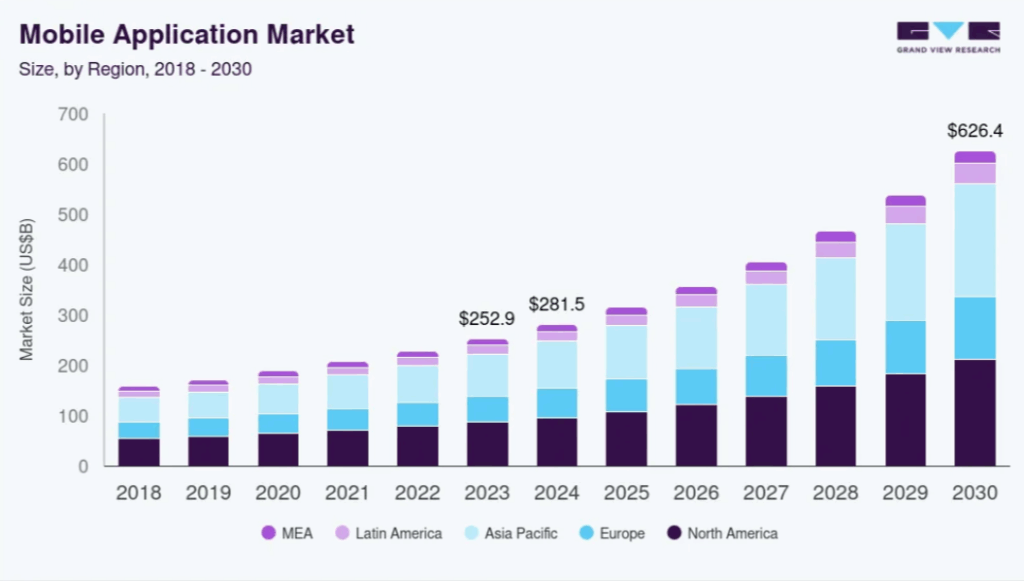
Nowadays, mobile phones play a crucial role in our lives, and when we talk about this, one thing that comes to our minds is mobile apps. These are the driving forces behind every smartphone. In fact, the global mobile app market size is forecasted to hit USD 626.39 billion by the end of 2030. And because of the growing market opportunities, businesses are building new apps to get a competitive edge.
However, there is no point in developing mobile apps if you are not connecting with your target audience. It is because mobile applications are now used for everything in our day-to-day lives, whether it’s ordering food, booking cabs, or taking a doctor’s consultation. So, even if you have an awesome app idea, it won’t guarantee success. The actual concern is about finding the right mobile app development frameworks.
Today, there are numerous options available in the market, so deciding on one is even tougher. Ultimately, businesses need to make smart and innovative decisions to pick the right mobile app development tools, database, and frameworks. And on that note, continue reading this blog, as here we are going to walk you through everything about mobile app frameworks, trends, and strategic considerations.
What are Mobile App Development Frameworks?
Most businesses don’t struggle to build an app anymore. Rather, they struggle to build the right one. That’s where mobile app development frameworks can help. These are not just coding libraries. Instead, these define how your app is built, how fast it ships, and how well it scales.
At a basic level, a framework provides reusable components, APIs, and tools that simplify development.
It decides:
- How much code do you reuse
- How your app performs in real-world conditions
- How expensive maintenance becomes later
And that’s why choosing between app development technologies is not just a technical step. It’s a product decision.
List of Top Mobile App Development Frameworks
Here are the best mobile app frameworks:
1. Flutter (Performance + UI Control)
It is one of the fastest-growing cross-platform app development frameworks.
It compiles to native code and uses its own rendering engine. That means fewer dependencies on platform UI components and more control over design.
Where Flutter works best:
- Custom UI-heavy apps
- MVPs that need fast iteration
- Products targeting both iOS and Android from day one
2. React Native
React Native continues to dominate among the best mobile app frameworks for a reason. It uses native components but connects them through a JavaScript bridge. That makes it flexible, but slightly less performant in complex scenarios.
Where it works best:
- Apps that evolve frequently
- Teams with web development experience
- Products that rely on third-party integrations
3. SwiftUI (iOS Native)
If you are building only for Apple users, SwiftUI is one of the best mobile app development frameworks.
SwiftUI offers deep integration with iOS and smooth performance. This is where native vs. cross-platform frameworks become clear: native wins in performance-critical use cases.
SwiftUI is best for:
- Premium iOS apps
- Apps requiring deep hardware integration
- High-performance consumer products
4. Jetpack Compose (Android Native)
This framework simplifies Android UI development. It removes a lot of boilerplate and speeds up development, while still keeping full native performance.
Where it works best:
- Android-first markets
- Apps needing strong performance consistency
5. Ionic
Ionic comes in the hybrid app development frameworks category.
It uses web technologies and wraps them into mobile apps. Faster to build, but performance depends on WebView.
Where it works best:
- Lightweight apps
- Dashboard or content-driven apps
- Rapid prototyping
6. Kotlin
Kotlin is now one of the most important app development technologies in the mobile ecosystem.
Google has officially made Kotlin the preferred language for Android development, and most modern Android apps are built with it.
But what makes Kotlin more relevant in 2026 is not just native development, it’s Kotlin Multiplatform.
Kotlin Multiplatform allows developers to share code across Android, iOS, the web, and even desktop, while maintaining native performance. That changes the entire conversation around native vs cross-platform frameworks.
Developers can:
- share business logic across platforms
- keep native UI where needed
- avoid performance trade-offs seen in traditional cross-platform frameworks
7. .NET MAUI / Xamarin (Enterprise Stack)
These frameworks are widely used in enterprise ecosystems.
They allow shared codebases with structured architecture, especially for businesses already using Microsoft technologies.
Where it works best:
- Enterprise applications
- Internal systems
- Scalable business apps
Brief Comparison of Mobile App Development Frameworks
Below is a practical comparison of mobile app development frameworks based on performance, architecture, and real-world use cases:
| Parameter | Flutter | React Native | Ionic | Swift/Kotlin | .NET MAUI |
| Type | Cross-platform | Cross-platform | hybrid | Native | Cross-platform |
| Programming Language | Dart | JavaScript | HTML, CSS, JS | Swift/Kotlin | C# |
| Performance | High (near-native) | Moderate–High | Moderate (WebView-based) | Very High | High |
| Rendering Approach | Own rendering engine | Native bridge | WebView | Native UI | Native UI abstraction |
| Code Reusability | High | High | Very High | Low | High |
| Development Speed | Fast | Fast | Very Fast | Slower | Moderate |
| UI Flexibility | Excellent | Good | Limited | Excellent | Good |
| Scalability | High | High | Medium | Very High | High |
| Best Use Case | MVPs, startups, rich UI apps | Scalable apps, frequent updates | Simple apps, dashboard | Performance-heavy apps | Enterprise apps |
| Learning Curve | Moderate | Low–Moderate | Low | High | Moderate |
How To Choose Top App Development Frameworks in 2026?
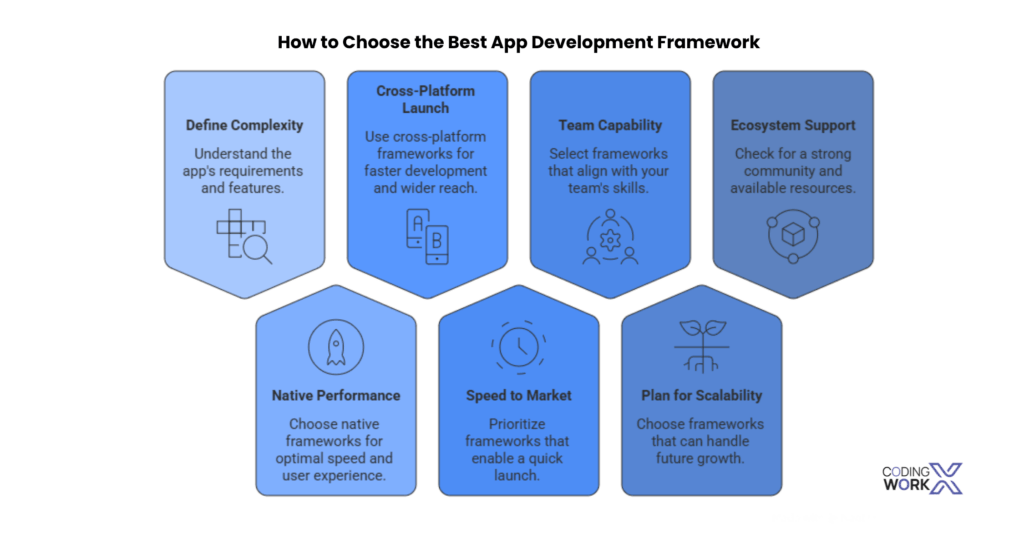
Picking the best mobile app frameworks can help your business grow faster. Also, it is advisable to take the help of a reliable mobile app development company to decide. Here are practical steps to help you pick the right one as per your business requirements.
1. Product Complexity
If your app depends heavily on device features or real-time processing, native is safer. If not, cross-platform app development frameworks can reduce effort significantly.
2. Speed to Market
If timing matters, frameworks like Flutter or React Native help launch faster. That’s why startups lean toward them.
3. Team Capability
Framework choice should match your team’s skills. Choosing the “best” framework that your team can’t execute properly is a common mistake.
4. Long-Term Scalability
This is where decisions break later. Frameworks that work for MVPs don’t always work at scale. Planning in advance is important.
5. Ecosystem & Support
Strong ecosystems reduce development friction. This is why React Native continues to stay relevant among mobile app development tools.
How Do Mobile App Frameworks Influence the Development Process?
Your chosen mobile app development tools influence every stage of the mobile app development process.
Speed: Using Flutter for cross-platform development speeds up the process.
Cost: When developers use reusable components, it can help lower the app development cost.
Performance: Native frameworks excel in device-specific features.
Maintenance: It is easy to maintain with shared codebases and module design patterns.
For example:
- Shared codebases reduce cost but increase dependency layers
- Native frameworks improve performance but require parallel development
- Hybrid approaches speed up delivery but require more optimization later
Even frontend frameworks for mobile apps influence UI consistency and responsiveness. So the framework is not just a tool. It’s the foundation of your development process.
Choose the right framework to build a high-performing mobile app. Get a Free Consultation
Mobile App Development Trends Shaping Framework Selection
Mobile app development framework decisions are now driven by mobile app development trends, not just developer preference. Here’s what’s actually changing:
1. AI Integration
AI-powered apps are now becoming a standard. AI integrations improve customized recommendations, user engagement, and overall functionality. Therefore, to stay competitive, businesses must collaborate with a reliable AI app development company to embed machine learning and smart automation into mobile apps.
Learn More: AI is Transforming Mobile App Development
2. Low Code/No Code
Now, low-code or no-code platforms are becoming popular for building tools and MVPs faster. These offer a cost-effective solution for rapid application development with minimum technical expertise.
3. Unified Development
Businesses want apps that work across mobile, web, and desktop. This is pushing the adoption of cross-platform app development frameworks even further.
4. Performance Optimization
Users expect fast apps. Even slight delays impact engagement. This is pushing teams back toward optimized frameworks and lightweight architectures.
Valuable Insights For Growing Enterprises
To ensure a successful launch, it is vital to consider these aspects:
- Getting strategic insights through app consulting services
- Understand app development cost and budget effectively
- Plan your project with an effective mobile app development methodology
- Stay ahead of the latest mobile app development trends
Read in detail: Cost to Develop an App in 2026?
Conclusion
Choosing the right mobile app development frameworks is now influenced by a few advancements that deliver the best value. Applications now are expected to offer robust security, privacy standards, and cross-platform expertise. Hence, regardless of whether you choose a native development framework for optimal performance or a cross-platform framework for faster delivery, it is vital to align your long-term business goals to build a successful app. Ultimately, the best framework is one that helps ship your products faster with your internal team’s skills.
It’s better to start by aligning your chosen framework with the internal team’s strengths, project complexity, and target audience. As a result, with the right process and right mobile app development tools, businesses can deliver a smooth user experience and stay relevant in an ever-evolving market.
Working with a trusted and experienced mobile app development company helps businesses choose the right tech stack and build future-ready mobile apps that offer real value to end users. Therefore, you need expert guidance; contact us and discuss your unique business requirements.
FAQs
1. What are the key features to look for in mobile development frameworks?
Businesses should look for hot reload, native API access, modular architecture, strong documentation, scalability, performance, and ease of integration.
2. How can I choose the best mobile app frameworks?
Consider product requirements, target audience, choice of platform (iOS, Android, or both), and the team’s experience before making the final decision.
3. What’s the difference between hybrid and native mobile app development frameworks?
Native frameworks deliver better performance and deeper integration. Hybrid app development frameworks offer faster development using web technologies but may compromise performance.
4. Which are the best hybrid app development frameworks?
Ionic is one of the best options for hybrid apps and is used widely for lightweight apps and quick builds.
5. What are the advantages of choosing cross-platform app development frameworks?
By using cross-platform frameworks, developers can use one codebase for multiple platforms, which reduces development time and effort, along with maintaining exceptional performance and a native-like UI.
6. Which framework is best for enterprise app development?
.NET MAUI, Flutter, and React Native are commonly used mobile app development frameworks for scalable enterprise solutions.
7. What are the new mobile app development trends that are influencing the framework selection?
In 2026, mobile app development is driven by key trends like AI integration, unified development, low code, performance optimization, and server-driven UI.