AI adoption inside businesses is accelerating faster than most companies expected. Gartner recently predicted that conversational AI vs generative AI systems will become a core layer of enterprise operations across customer service, sales, support, and internal workflows over the next few years. At the same time, businesses are still struggling to understand where conversational AI ends and where generative AI begins.
That confusion creates expensive decisions.
Some companies deploy AI chatbots expecting human-level creativity. Others integrate generative AI tools into customer support without considering compliance, hallucinations, or workflow accuracy. The result is usually a poor AI customer experience, frustrated users, and disconnected automation strategies.
The discussion around Conversational AI vs Generative AI is not just technical anymore. It directly affects customer engagement, operational costs, automation planning, and enterprise scalability.
While both technologies use artificial intelligence and natural language processing, they solve completely different business problems.
One is designed for interaction. The other is designed for creation. And businesses that understand this difference early are building much smarter AI ecosystems.
What is Conversational AI?
Conversational AI refers to AI systems designed to simulate human conversations through text or voice interactions.
These systems use technologies like:
- Natural Language Processing (NLP)
- Machine learning
- Intent recognition
- Context management
- Speech processing
The purpose is simple: enable machines to communicate naturally with humans.
Most modern customer support bots, virtual assistants, voice agents, and enterprise helpdesk systems fall under conversational AI applications.
Unlike traditional rule-based bots, conversational AI systems understand user intent and improve responses over time through continuous learning.
For example, if a user types, “I need to reschedule my delivery.”
The AI identifies the request, understands the context, and triggers the appropriate workflow automatically.
That is why conversational AI use cases are heavily centered around support, communication, and operational efficiency.
What is Generative AI?
Generative AI focuses on generating entirely new content.
Instead of only understanding conversations, it creates outputs such as:
- Text
- Images
- Audio
- Videos
- Code
- Reports
- Emails
- Product descriptions
Large language models (LLMs) power most modern generative AI systems.
Platforms like ChatGPT, Claude, Gemini, and Copilot are examples of generative AI tools.
These systems learn patterns from massive datasets and generate human-like responses dynamically.
For example: “Write a launch email for a fintech product.” The AI creates completely original content based on learned language structures.
This is why businesses increasingly invest in Generative AI Development Services to automate content operations, internal workflows, and productivity systems.
Conversational AI vs Generative AI: The Core Difference
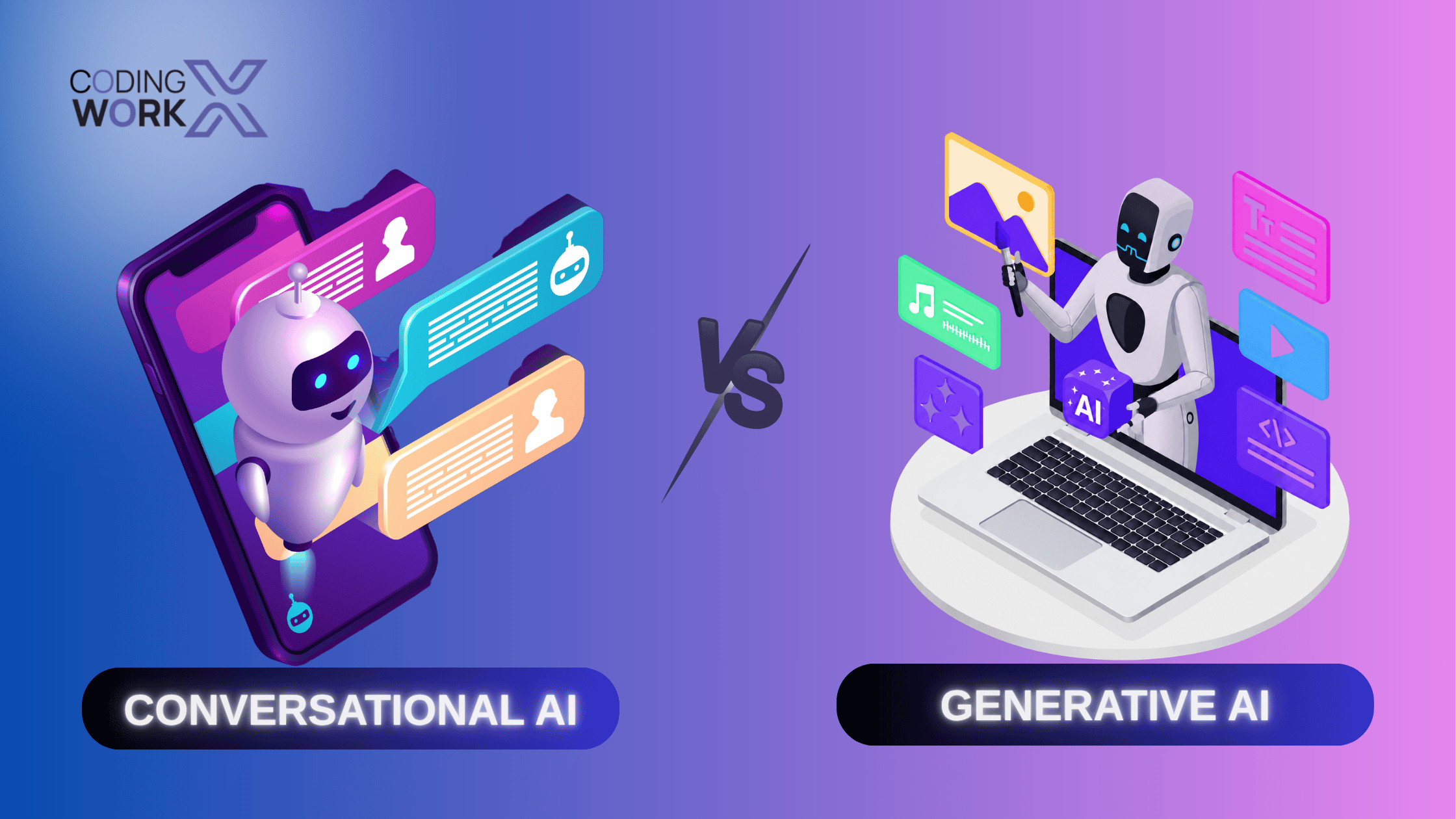
The easiest way to understand conversational AI vs generative AI is this: Conversational AI focuses on human interaction. Generative AI focuses on content creation. Both use NLP and machine learning, but their objectives are fundamentally different.
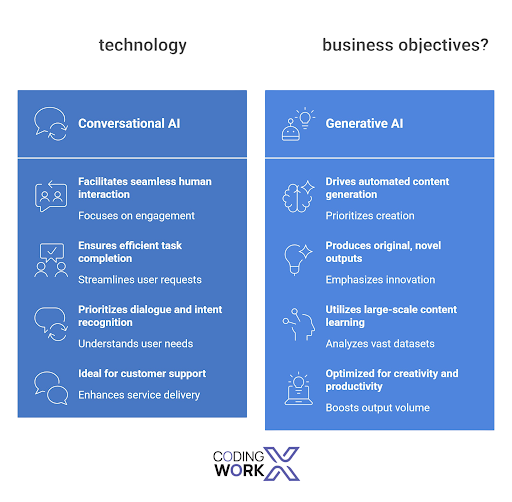
| Feature | Conversational AI | Generative AI |
| Primary Purpose | Human interaction | Content generation |
| Main Goal | Task completion | Creating original outputs |
| Common Outputs | Responses and workflows | Text, code, media, content |
| Training Focus | Dialogue and intent recognition | Large-scale content learning |
| Best For | Customer support | Creativity and productivity |
| Enterprise Use | Automation and communication | Content and knowledge generation |
This is where the confusion around AI chatbots vs generative AI usually starts. Not every chatbot uses generative AI. And not every generative AI tool is designed for conversations.
How Conversational AI Works
Conversational AI systems rely on structured dialogue systems and NLP models.
The process usually includes:
1. Understanding user input
2. Detecting intent
3. Identifying entities and context
4. Generating a suitable response
5. Executing workflows if needed
Modern conversational AI platforms can also track conversation history and personalize responses based on previous interactions.
This makes them highly effective for:
- Customer support
- Appointment scheduling
- Ecommerce assistance
- Banking support
- Internal enterprise automation
Businesses investing in AI-powered customer experience systems are increasingly combining conversational AI with CRM and workflow platforms to create seamless customer journeys.
How Generative AI Works
Generative AI uses transformer-based deep learning models trained on enormous datasets.
Instead of selecting predefined answers, the model predicts what content should come next based on context and probabilities.
That allows it to generate:
- Long-form content
- Marketing copy
- Code snippets
- Research summaries
- AI-generated media
- Dynamic recommendations
Unlike conversational AI, generative systems are less workflow-focused and more creativity-focused.
This is why generative AI applications are expanding rapidly across marketing, SaaS, software development, and enterprise productivity environments.
Conversational AI Use Cases
The biggest strength of conversational AI is scalable interaction. It helps businesses automate repetitive conversations without completely removing the human experience.
Customer Support Automation
This remains one of the most common conversational ai use cases.
AI assistants now handle:
- Refund requests
- Ticket creation
- Password resets
- Order tracking
- Appointment booking
- FAQ management
This reduces operational pressure while improving response speed.
Modern AI chatbot development company solutions are now integrating multilingual support, sentiment analysis, and voice capabilities into enterprise support systems.
Banking and Finance
Banks use conversational AI applications for:
- Fraud alerts
- Account assistance
- Loan queries
- KYC workflows
- Balance inquiries
These systems improve accessibility while reducing support costs.
Healthcare Assistance
Healthcare providers use conversational AI for:
- Patient support
- Symptom guidance
- Prescription reminders
- Appointment scheduling
This improves operational efficiency without overloading staff.
Enterprise IT Support
Many organizations now deploy AI copilots in enterprises to automate internal requests.
Employees can ask:
- “Reset my credentials.”
- “Generate onboarding documents.”
- “Check leave balance.”
The AI handles tasks instantly without manual intervention.
Generative AI Use Cases
Generative AI becomes valuable when businesses need creativity, personalization, and knowledge generation at scale.
Content Creation
This is the fastest-growing area for generative ai use cases.
Businesses now automate the following:
- Blog writing
- Product descriptions
- Email campaigns
- Ad copy
- Sales messaging
- Internal documentation
That significantly reduces production time.
Software Development
AI coding assistants help developers:
- Generate code
- Debug errors
- Create documentation
- Suggest optimizations
This is changing enterprise development workflows rapidly.
Enterprise Knowledge Systems
Companies now use generative AI solutions to summarize internal documents and answer employee questions using natural language interfaces.
This reduces search time and improves productivity.
Personalized Marketing
Generative AI can dynamically personalize:
- Emails
- Recommendations
- Landing pages
- Campaign messaging
This creates more adaptive AI customer experience systems across eCommerce and SaaS businesses.
AI Chatbots vs Generative AI: Why the Lines Are Blurring
Earlier chatbots were heavily scripted. They followed predefined flows and decision trees. But modern conversational AI and chatbots increasingly integrate generative AI underneath.
That means a chatbot can now:
- Understand user intent
- Generate personalized replies
- Retrieve knowledge dynamically
- Handle open-ended conversations
This hybrid approach creates much more natural interactions.
For example, a customer support assistant may use conversational AI for workflow execution while using generative AI to create personalized responses in real time.
This is why the future is not conversational AI vs generative AI. It is conversational AI combined with generative intelligence.
Real Examples of Conversational AI and Generative AI
Conversational AI Example
Virtual banking assistants like Erica from Bank of America help users:
- Check balances
- Monitor transactions
- Receive fraud alerts
- Access financial information
The focus is on interaction and workflow support.
Generative AI Example
GitHub Copilot helps developers generate code suggestions in real time.
The focus is on content and productivity generation.
Hybrid AI Example
Modern ecommerce assistants combine conversational AI vs generative AI models.
The system can:
- Answer support queries
- Recommend products
- Generate personalized responses
- Complete transactions
This creates a much stronger customer experience.
Challenges of Conversational AI
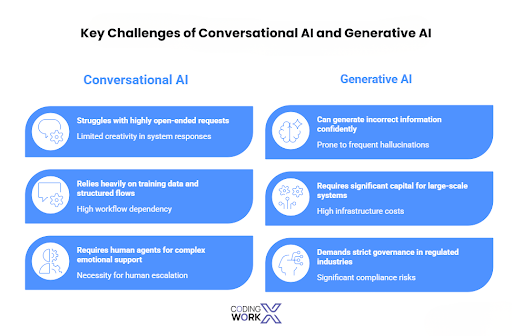
Conversational AI still faces several operational limitations.
Limited Creativity
Traditional conversational systems struggle with highly open-ended requests.
Workflow Dependency
Performance depends heavily on training data and structured flows.
Human Escalation Needs
Complex emotional or sensitive conversations still require human agents. Research also shows customers often prefer humans for complicated support interactions.
Challenges of Generative AI
Generative AI also introduces major enterprise concerns.
Hallucinations
LLMs can generate incorrect information confidently.
Compliance Risks
Regulated industries require strict governance over AI-generated content.
Infrastructure Costs
Large-scale generative AI systems can become expensive to maintain.
That is why businesses increasingly focus on choosing the right AI model instead of deploying AI tools blindly.
How Businesses Should Choose Between Conversational AI vs Generative AI
The decision on conversational AI vs generative AI depends entirely on the business objective.
If the priority is:
- Customer support
- Workflow automation
- Service efficiency
- Human interaction
Then conversational AI platforms are the better fit.
If the priority is:
- Content generation
- Creativity
- Knowledge automation
- Internal productivity
Then generative AI applications make more sense. But most enterprises today require both.
That is why businesses increasingly combine:
- Conversational AI platforms
- Generative AI solutions
- Enterprise copilots
- Workflow automation
- Knowledge retrieval systems
This hybrid approach creates scalable intelligent systems across departments.
The Future of Conversational AI and Generative AI
The future of enterprise AI is converged intelligence.
Businesses are moving toward systems that combine:
- Conversational interfaces
- Generative outputs
- Real-time workflows
- Knowledge retrieval
- Autonomous task execution
We are already seeing rapid growth in:
- AI-powered customer experience
- AI copilots
- Autonomous agents
- Enterprise AI assistants
- Multimodal AI systems
Companies investing early in scalable AI infrastructure will likely gain operational and customer engagement advantages over the next decade.
Final Thoughts
The discussion around conversational AI vs generative AI is not about choosing one technology over the other.
It is about understanding where each technology creates value. Conversational AI excels at interaction, workflow management, and customer communication.
Generative AI excels at creativity, content generation, and knowledge automation. The most effective enterprise AI strategies now combine both technologies into connected ecosystems.
Whether you are building support automation, deploying enterprise copilots, or investing in generative AI solutions, long-term success depends on aligning the right AI architecture with the right business outcome.
Businesses that understand this distinction early will build far more scalable and intelligent systems moving forward.
FAQs: Conversational AI vs Generative AI
What is the main difference between conversational AI vs generative AI?
Conversational AI focuses on structured interactions and workflow automation, while generative AI creates original content like text, code, and media using large language models.
Are conversational AI and chatbots the same?
Not always. Traditional chatbots are rule-based, while modern conversational AI and chatbots use NLP and machine learning for more human-like interactions.
What are the most common conversational AI applications?
Customer support, healthcare assistance, banking support, appointment booking, and enterprise helpdesk automation are some of the most common conversational AI applications.
What are popular generative AI use cases?
Generative AI use cases include content generation, coding assistance, marketing automation, research summarization, and enterprise knowledge management.
How much does it cost to build an AI chatbot?
The cost depends on features, integrations, AI models, and deployment complexity. Businesses can explore this detailed guide on AI chatbot development cost to understand pricing factors better.