
Travel didn’t change much for years. Pricing was reviewed on fixed schedules. Hotels adjusted rates seasonally. Booking platforms listed options and left the rest to filters. That model held up until “good enough” stopped protecting margins.
Now the pressure is visible everywhere. Airlines are operating on margins under 5% even in strong years. Hotels in dense markets are chasing incremental RevPAR gains. OTAs are dealing with shorter sessions and faster drop-offs. In this kind of environment, the difference between using AI and not using it shows up directly in revenue, not just in operations.
That’s also why the market is moving the way it is. AI in tourism was valued at $2.95 billion in 2024 and is projected to reach $13.38 billion by 2030, growing at 28.7% CAGR. This isn’t speculative momentum. It’s coming from real outcomes: lower maintenance costs for airlines, better pricing performance for hotels, and higher conversion rates for platforms that are already applying it.
This guide covers where AI in travel is actually creating impact right now: in airlines, hotels, and tourism platforms—with real data behind the claims. What it means operationally, what the use cases are, where the challenges sit, and what comes next.
What Is AI in Travel?
AI in travel means the use of machine learning, natural language processing, predictive analytics, and computer vision to improve how airlines, hotels, and tourism businesses operate, price their offerings, and serve customers. It is a layer of intelligence embedded into the systems these businesses already run.
At an operational level, AI in travel means a hotel’s room rate updating every hour based on live demand signals rather than a weekly spreadsheet review. It means an airline’s disruption system rebooking 40,000 affected passengers in minutes rather than hours. It means a booking platform surfacing the right property to the right traveler before they’ve finished typing their search.
What makes AI in travel and tourism different from earlier waves of travel technology is the feedback loop. Traditional systems only do what you tell them. On the other hand, AI travel systems learn from outcomes and improve continuously.
The role of AI in travel and tourism now covers the full operational stack. Revenue management and dynamic pricing. Customer service and personalization. Predictive maintenance and fleet operations. Fraud detection and security. The breadth is wide. But the common thread is the same: decisions that used to require human analysis of historical data are now made in real time, with greater accuracy and at a scale no human team could match.
AI in Airlines: Where the Economics Are Most Visible
Airlines are the most data-rich businesses in travel. A single Boeing 787 generates roughly 500GB of operational data per flight. An airline running 500 daily departures produces more structured data per day than most mid-sized technology companies generate per year. For a long time, that data sat largely untouched—processed into reports that reached the right desks too late to act on.
That’s what AI in travel is changing.
Dynamic Pricing and Revenue Management
Traditional airline pricing used historical booking curves and fixed fare classes. AI-powered revenue management systems go considerably further. They process competitor pricing, search volume trends, macroeconomic signals, local events, weather data, and booking velocity, and they update fares continuously. Not twice a week. Not nightly. Continuously.
The financial impact is documented at multiple levels. A McKinsey analysis found that AI-driven revenue management solutions enhance airline revenues by 5–10% through improved fare availability and more precise pricing decisions.
Predictive Maintenance and Fleet Reliability
AI in airlines changes the way maintenance actually happens on the ground. Today’s aircraft are constantly sending signals from engines to hydraulics to onboard systems; every second they’re in operation. Instead of waiting for scheduled inspections, teams now rely on systems that quietly watch this data and spot small irregularities early, often before anyone would notice during a manual check.
And the shift isn’t theoretical. Airlines using predictive maintenance are seeing real gains—less downtime, fewer unexpected failures, and tighter control over costs. Studies from McKinsey & Company points to downtime reductions of nearly a third and maintenance savings in the same range. Programs like Delta APEX (Advanced Predictive Engine) show how this plays out over time, with a sharp drop in maintenance-related cancellations and consistent cost savings year after year.
Flight Operations and Disruption Management
Fuel represents 20–30% of an airline’s operating costs. AI-powered route optimization, factoring in real-time weather, air traffic congestion, and aircraft performance data, consistently delivers fuel savings that compound significantly at fleet scale. British Airways saved up to 100,000 tons of fuel in a single year through AI-powered flight planning. Swiss International Air Lines saved $5.4 million in a single year by optimizing over half its network flights using AI.
Disruption management is where the speed advantage of AI is most obvious to passengers, even if they don’t see it. When weather cascades through a hub, an AI disruption system can model hundreds of recovery scenarios simultaneously, rebooking passengers, reassigning aircraft, and reallocating crew in the time it takes a human dispatcher to open a spreadsheet. AI implementations in airline customer service reduce waiting times by up to 80% during irregular operations, which is precisely when passenger frustration peaks and loyalty decisions are made.
AI in Hospitality: From Dynamic Pricing to Guest Intelligence
Hotels face a structural revenue problem that AI is uniquely positioned to solve. Every unsold room night is revenue gone forever; it can’t be stored and sold tomorrow. At the same time, demand is highly variable, driven by factors (local events, competitor pricing, flight search trends, and macroeconomic shifts) that no human revenue manager can monitor simultaneously.
AI in hospitality helps anticipate these signals faster.
Revenue Management and Dynamic Room Pricing
AI in hospitality starts with pricing. Modern AI revenue management platforms and tools like Duetto, IDeaS, and Atomize ingest data from the property’s PMS, competitor rate feeds, OTA performance metrics, event calendars, and demand signals and generate room-level pricing recommendations that update in near real time.
The results are measurable and consistent across the industry. Pulling back to the industry level, hotels using AI-driven revenue management report an estimated 17% total revenue increase over properties still running traditional methods, and 86.1% of hoteliers now say they depend on AI for forecasting and demand analytics.
For hotel operators and hospitality startups building direct booking platforms, this is where the ROI case is clearest and the payback window is shortest. A property doing $5 million in annual room revenue that improves RevPAR by 12% through AI-driven pricing adds $600,000 in annual revenue before accounting for the cost savings on manual analyst time.
Guest Personalization and AI Concierge
In hospitality, the difference between something that feels truly personal and something that’s just templated has become very obvious. And it matters more now. AI in hospitality is closing that gap, not just for large brands like Marriott International, but even for smaller independent hotels that have the right systems in place.
What’s changed is how data gets used. Hotels can now look at past bookings, on-property spending, loyalty behavior, and even real-time actions to understand what a guest is likely to want next. So instead of generic offers, you start seeing well-timed upgrade suggestions, relevant spa or dining bundles, and even follow-ups when a stay didn’t go as expected. It feels less like marketing and more like someone actually paying attention.
For properties and hospitality startups integrating AI chatbot development into guest communication, the 24/7 availability eliminates the friction of front desk calls and email response delays. 65% of global travel leaders identify chatbots and virtual assistants as the most impactful application of generative AI in their space, which positions this not as a differentiator but as an emerging baseline expectation.
Housekeeping, Operations, and Cost Structure
Labor makes up approximately half of hotel gross operating margins. This is where back-of-house AI delivers impact that doesn’t show up in guest reviews but shows up clearly in financial statements. Predictive check-out modeling using booking data, flight information, and historical patterns lets housekeeping managers schedule staff with precision rather than padding every shift for worst-case occupancy. Energy management AI adjusts HVAC and lighting based on occupancy in real time, reducing utility costs without degrading comfort. Maintenance anomaly detection catches equipment issues before they become guest-facing failures.
Revenue teams using AI for demand analytics save up to 50% of their time on manual analysis, time that redirects toward strategy, team development, and guest-facing priorities.
AI in Tourism Platforms and OTAs: Intelligent Discovery at Scale
OTAs and tourism platforms operate in high-volume, high-friction environments. Thousands of listings. Prices are changing constantly. Users with 8 tabs open, comparing options, are struggling to meaningfully differentiate. The traditional search-and-filter model worked reasonably well when travelers had patience and time. Both have decreased.
Conversational Planning and Natural Language Search
The shift from search-and-filter to conversational AI planning is already underway at the major platforms. Expedia, Booking.com, and Google Travel have all integrated LLM-powered planning interfaces that let travelers describe what they want in natural language — “something quiet near the coast, family-friendly, under $200 a night, in June” — and receive curated results that match intent, not just keywords.
The engagement data from early deployments is significant. Expedia’s AI travel assistant reported a 30% increase in session depth versus the traditional search interface; users explored significantly more content per visit, which increases the probability of booking before they leave the platform. For travel platform founders evaluating where AI development sits in their product roadmap, conversational search is now less a differentiator and more a competitive necessity in the 2026 market.
Hyper-Personalization and Recommendation Engines
AI recommendation engines on travel platforms work on the same underlying mechanics as Netflix’s content engine or Amazon’s product discovery, processing a user’s search history, booking behavior, review patterns, and real-time context to surface options that are genuinely relevant to that specific person, not just statistically popular options.
The AI-driven travel experience personalization market was valued at $3.61 billion in 2024 and is forecast to reach $18.01 billion by 2032 at a 22.34% CAGR, which reflects how central personalization has become to platform unit economics. Personalized recommendations consistently improve booking conversion rates by 15–35% versus generic search results. That lift, applied across millions of monthly users, is the difference between a platform that grows and one that doesn’t.
Fraud Detection and Secure Transactions
High-volume booking platforms are inherently high-value fraud targets. Payment fraud, account takeover, and fake inventory are all problems that scale with platform growth. AI fraud detection systems monitor behavioral patterns across the entire transaction flow, flagging anomalies in booking frequency, payment behavior, device fingerprinting, and session patterns, and intercept fraudulent transactions before they are complete. The key advantage over rule-based fraud filters is adaptability: AI systems learn new fraud patterns in near real time, whereas rule-based systems require manual updates that lag weeks or months behind emerging attack vectors.
Demand Forecasting for Destinations and Operators
Tourism boards, destination management organizations, and platform operators are using AI to model travel demand at a destination level, not just at the property or route level. By ingesting flight search data, social media trend signals, visa application volumes, and historical arrival data, AI forecasting systems can project tourism flows months ahead with significantly higher accuracy than traditional models.
For smaller tour operators and regional accommodation providers, this intelligence levels the playing field that was previously tilted toward the large platforms. A tour operator in Rajasthan who can see rising search interest from German travelers 90 days out can adjust pricing, inventory, and marketing budget before that demand peak arrives, not after.
Real Business Benefits of AI in Travel: What the Numbers Show
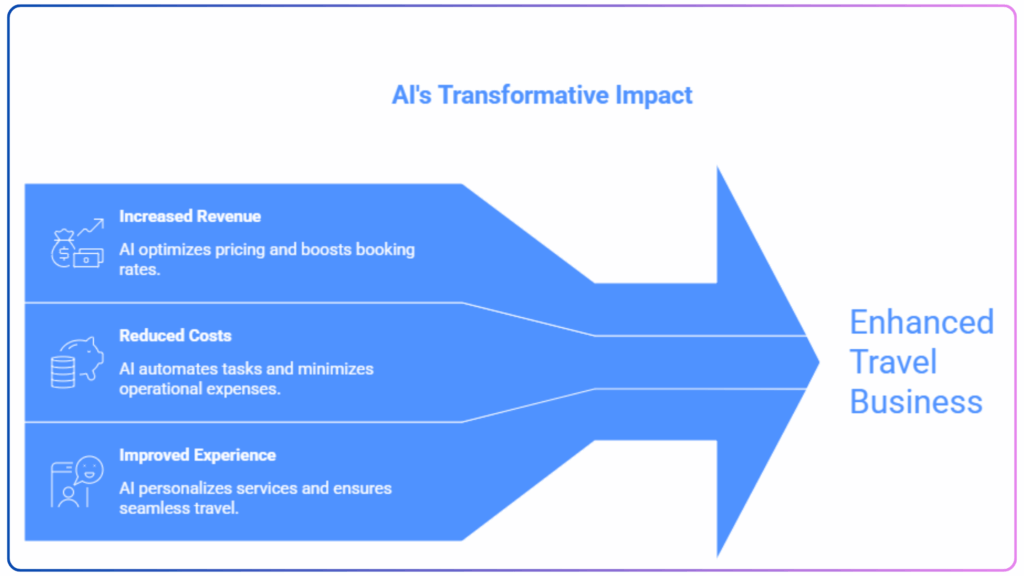
The business case for AI in travel runs across four dimensions, and each one is measurable.
Revenue Growth
AI-driven pricing consistently delivers 5–10% revenue improvements in airlines and 10–17%. RevPAR gains in hotels. Personalized recommendation engines improve booking conversion rates 15–35%.
Pre-arrival upselling powered by AI adds 5–12% to ancillary revenue per stay. These aren’t projections. Rather, they’re documented outcomes from properties and carriers already running these systems.
Operational Cost Reduction
It is the second major driver. AI-driven predictive maintenance cuts airline maintenance costs by up to 15% while reducing unscheduled downtime by 30%. Hotel labor scheduling optimization reduces overtime and over-staffing costs. AI chatbots handle approximately 80% of customer service interactions in travel before human escalation is required, which significantly reduces support costs per booking.
Better Customer Experience
Higher personalization accuracy leads to higher satisfaction scores. Higher satisfaction drives repeat bookings and word-of-mouth. Fewer disruptions, maintenance-related or service-related, reduce churn. These effects take longer to show up in financial reports than pricing optimization, but they have a longer runway of impact.
Competitive Positioning
91% of airlines globally plan to invest in AI programs by 2026. In hospitality, AI revenue management is already the standard at chains like Marriott, Hilton, and IHG. The question for mid-market operators is not whether AI becomes standard. Rather, it’s whether they build toward it proactively or find themselves on the losing side of a structural gap.
AI Use Cases in Airlines and Hotels: A Decision Framework
Take a look at these use cases:
| Business Function | AI Application |
| Pricing | Dynamic fare and room rate management |
| Maintenance | Predictive fault detection |
| Customer Service | AI chatbots and virtual agents |
| Personalization | Behavioral recommendation engines |
| Operations | AI scheduling and demand planning |
| Fraud Prevention | Real-time behavioral anomaly detection |
| Demand Forecasting | Route and destination demand modeling |
Challenges of Implementing AI in Travel
Here are some of the problems in integrating AI in travel:
Fragmented Data Across Disconnected Systems
Most hotels and airlines run across multiple systems like PMS, CRS, GDS, and channel managers that were never built to share data. AI is only as reliable as what it trains on, and 60% of hoteliers already cite demand unpredictability as their top pricing challenge. A lot of that unpredictability is a data problem, not a market problem.
Privacy Compliance Can’t Be Retrofitted
AI systems in the travel process analyze travel patterns, payment data, and, in some cases, biometric data. GDPR, PDPA, and other regional regulations require privacy-first architecture to be built in from day one. Organizations that treat compliance as an afterthought consistently run into both regulatory exposure and user trust issues down the line.
Legacy Infrastructure Slows Every Deployment
The core systems at most established hotels and airlines are 15–25 years old. Connecting modern AI layers to PMS connectors, GDS feeds, and airline PSS systems without disrupting live operations take significantly longer than most initial project scopes account for. Underestimating this is the most reliable way to blow a deployment budget.
Internal Resistance Is a Real Risk
A revenue manager with 15 years of pricing instinct doesn’t automatically trust an AI recommendation that contradicts their call. The operators seeing the best outcomes are the ones who built explainability into the system, showing teams why a recommendation was made, not just what it is. Adoption is a product problem, not just a change management one.
Future of AI in the Travel Industry: The Next 36 Months
Three developments will define AI in travel from 2026 through 2028. Each is already in early deployment. The question is which operators will be positioned to benefit when they reach mainstream adoption.
Agentic AI will change what “booking” means.
The current generation of AI in travel is largely advisory, like it recommends, and a human decides. Agentic AI takes action autonomously. A traveler tells an AI system their preferences, budget, and dates, and the system searches, compares, negotiates, books, and manages changes without further input.
By 2028, more than half of all bookings are forecast to involve an AI agent at some point in the shopping journey. For operators, this means competing not just for human attention but also for AI attention, which puts a premium on clean, machine-readable pricing and availability data. For product teams building AI agent development solutions, travel is one of the clearest and most commercially valuable use cases in the market right now.
Multimodal AI will transform the planning and in-destination experience.
Systems that process text, images, audio, and video simultaneously will enable a different kind of travel discovery. A traveler photographs a landscape and asks to find accommodation that matches that aesthetic within budget. A museum loads an AI translation layer that converts audio guides into a visitor’s native language in real time. A hotel’s concierge app processes a guest’s photo of a dish they ate and recommends where to find something similar nearby. These aren’t speculative features. Rather, they’re being built on top of existing multimodal AI infrastructure that exists today and will reach reliable deployment in the 18–24 months ahead.
Carbon intelligence will move from optional to mandatory.
73% of travelers say they are willing to pay a premium for eco-friendly travel options. Corporate travel policies at major employers increasingly require carbon footprint reporting per trip. AI systems that can calculate and display carbon footprint data per booking option, optimize itineraries for lower emissions, and verify sustainability certifications at scale are moving from pilot programs to platform requirements.
By 2027, expect carbon intelligence to be a default feature in enterprise travel management systems, not an add-on.
Building an AI-Powered Travel Product: What to Get Right First
If you’re a hotel group evaluating AI revenue management or a startup founder building a travel platform with AI at its core, the decisions that matter most happen before a single line of code is written.
So, here are simple steps on how you can build an AI-driven travel solution:
Define a specific operational problem before selecting any technology.
AI revenue management, AI-powered guest communication, and AI demand forecasting are different systems with different data requirements, integration timelines, and payback periods.
Data infrastructure before AI deployment.
Clean, unified, well-connected data is what makes AI models useful. A fragmented data layer produces recommendations that are wrong, inconsistent, or unreliable.
Start with the highest-ROI use case and validate it before expanding.
For hotels, that’s usually pricing and revenue management, fastest payback, and most measurable impact. For airlines, it’s revenue management and predictive maintenance. For tourism platforms, it’s personalized recommendations and conversion optimization. Build one thing well. Get data from real users. Then let that data drive the next phase of the roadmap.
Choose a development partner who understands the domain.
Building AI for a hotel is not the same as building AI for an e-commerce retailer. PMS integrations, OTA data feeds, GDS connectivity, and airline PSS systems—the domain context matters enormously for building something that functions correctly in a live production environment rather than a controlled demo.
At CodingWorkx, we build custom software development and AI solutions for travel operators, hospitality startups, and OTA platforms. We start by understanding the operational reality, the data you have, and the constraints that actually apply before recommending any technical architecture. If you’re working through where AI fits in your travel business, reach out and let’s work through it together.
Frequently Asked Questions
How much does it cost to integrate AI in travel?
The cost depends on the complexity of the project and can range from $50,000 to $300,000 for large platforms. Also, cost can fluctuate based on integrations, data readiness, and how your system scales.
What are the benefits of AI in tourism?
AI helps tourism businesses personalize travel experiences, improve customer support with chatbots, and optimize pricing and demand forecasting. It also enhances operational efficiency, making bookings, recommendations, and trip planning faster and more accurate.
Can you integrate AI into legacy systems?
Yes, being a leading travel and hospitality app development company, we can integrate AI into your existing booking systems and operational platforms.
How long does it take to implement AI in travel?
The final timeline depends on different factors like scope, data readiness, etc. However, small projects can take months; on the other hand, enterprise-wide integration may take longer.