
The e-commerce industry is one of the leading adopters of artificial intelligence, with multiple use cases that streamline workflows, logistics, and demand forecasting. And businesses that adopt AI can boost revenue up to 12%.
Even now, buyers are moving away from traditional search and turning to ChatGPT and other platforms to browse and discover products. On the business side, 95% of e-commerce businesses that are utilizing AI technology are seeing a boost in ROI. So, now the question is not if AI belongs in eCommerce. Rather, it is how you can use it in the best way and create long-term success.
Here in this article, what is AI in e-commerce actually? Benefits of eCommerce AI, challenges, and much more.
What is AI in eCommerce?
AI in eCommerce is about integrating AI technologies, such as machine learning and natural language processing, to improve the shopping experience. It’s like when an online store suggests relevant products as per your shopping history. AI algorithms analyze your browsing history, storefront clicks, and past interactions to offer tailored suggestions.
eCommerce AI is not just about enhancing customer experience. Rather, it streamlines business operations, helps you make data-driven decisions, and removes repetitive tasks. Gen AI helps businesses write custom product descriptions, marketing content, and both internal and external business communications. Furthermore, advanced AI technologies, such as predictive AI, can analyze historical sales data to forecast future trends and customer requirements. Ultimately, these insights help improve inventory and implement a dynamic pricing structure.
Benefits of AI in Online Shopping
Leading e-commerce brands like Amazon have long used AI to improve customer experience, streamline logistics, and boost growth. However, AI in eCommerce is not just for big companies; it is now delivering measurable outcomes across businesses of all sizes.
Furthermore, AI tools can boost a 25% improvement in customer satisfaction, revenue, or operational cost reduction. The benefits of AI in eCommerce are clear, from product recommendations to faster support and smarter inventory management.
More Targeted Marketing
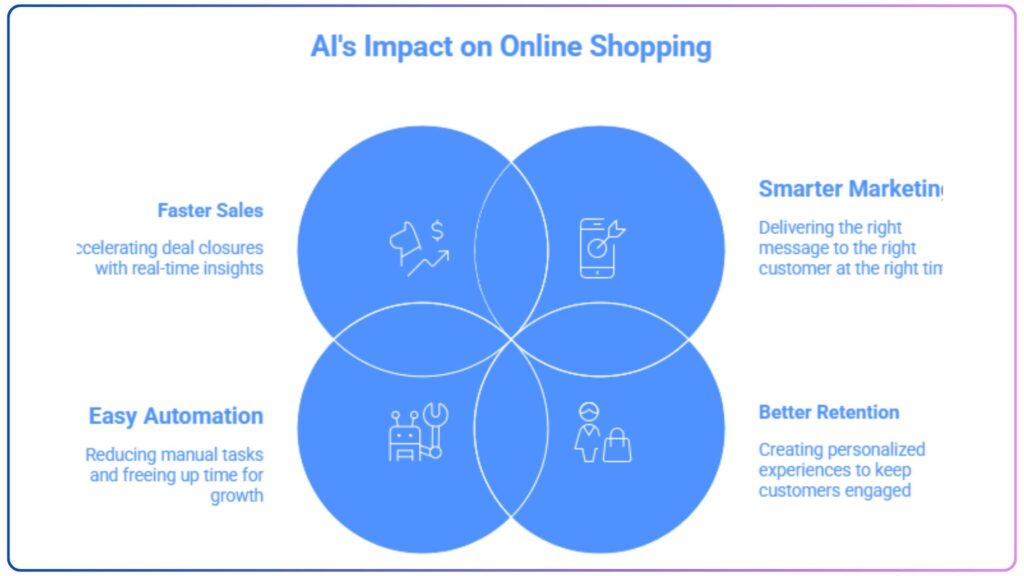
AI in eCommerce allows brands to analyze customer behavior, purchase history, and engagement patterns, so they can deliver the right message to the right person at the right time. Also, with machine learning and predictive analytics, e-commerce businesses can turn customer data into custom messaging that feels personal.
Better Customer Retention
Custom experiences build loyalty. AI-powered personalization helps eCommerce businesses tailor their messaging based on individual behaviors and preferences. These AI tools help brands stay updated while building trust along the way.
Smooth Automation
AI eCommerce software takes automation to the next level. They can handle time-consuming tasks like product recommendations, round-the-clock customer support, and loyalty program triggers. So, you can focus on strategy, not on manual work.
Efficient Sales Processes
AI tools also help you close sales faster. They automate lead scoring and tracking buyer intent and offer real-time insights. This helps shorten the sales cycle and improve results at every stage. Many e-commerce businesses using AI see up to 25% faster deal closures and can cut costs by as much as 60%.
How AI Is Transforming Online Stores: 7 Core Use Cases
While there are multiple AI use cases in e-commerce, here we have listed the top ones only.
Personalized Product Recommendations
AI tools make it easy to offer custom product recommendations that drive conversions and increase order value. Machine learning models now predict what customers are most likely to buy next by analyzing past purchases and history. So, eCommerce brands can surface relevant products in real time and improve the shopping experience and overall sales.
Improved Customer Service
With chatbots and virtual assistants, businesses can deliver exceptional customer support. They can facilitate simple transactions, and businesses can focus on more complex business issues. Also, virtual agents are available 24/7, so customers’ FAQs and issues can be addressed at any time without making them wait.
Pricing Optimization
AI-enabled dynamic pricing is a strategy for adjusting your product’s price based on supply and demand.
With the right data, today’s tools can predict when and what to discount, dynamically calculating the minimum discount required to complete the sale.
Optimizing for Generative Search Engines (GEO)
As generative AI is now integrated into search platforms, e-commerce brands must change their SEO approach. Generative engine optimization (GEO) utilizes large language models to offer direct answers and product recommendations within the search experience. And this is shifting traffic from traditional blue links. So, to stay competitive, e-commerce brands need to optimize product data, content, and metadata, so these search engines can recommend their products.
Ultimately, by aligning how GEO platforms show results, brands can maintain discovery and relevance.
Smart Logistics
Getting your products from the warehouse to customers effectively is a big task, but AI in e-commerce makes the process smarter. Now businesses can optimize shipping routes, forecast delivery delays, and manage inventory effectively. In addition, real-time and predictive analytics decrease costs and shorten the delivery window.
Now, AI in logistics supports warehouse automation, demand forecasting, and return management, and all of this leads to a smooth and scalable fulfillment strategy.
Customer Segmentation
AI-powered eCommerce solutions help companies segment their audiences based on behavior, preferences, and purchase history. These dynamic customer segmentations help tailor messaging and product promotion to the right person.
Agentic Commerce
Agentic commerce is the next evolution of e-commerce. Now, agentic AI tools make decisions, take actions and learn from outcomes. AI in e-commerce can handle tasks like price adjustments and inventory reordering based on real-time customer behavior and your business goals.
And as this technology advances, eCommerce brands can use agentic AI to run advanced storefronts that optimize themselves continuously.
Influence of AI in eCommerce
Below are a few ways in which AI is changing the world of eCommerce:
Identifying Optimal Pricing
When businesses can accurately and consistently hit the price optimization sweet spot, prices go high. AI-powered systems analyze large datasets and enable dynamic pricing so businesses can change prices based on supply and demand.
Creating a Smart Website
By integrating natural language processing, AI systems can understand the shopper’s query and can more confidently assess what they are trying to find and present the search results accordingly. Even AI suggests missing words or phrases and automatically corrects spelling errors.
Additionally, AI facilitates the entry of customer queries for those who would rather use voice or image search. AI systems can use visual search to analyze an image, like a picture of a street-wearable item, and then recommend related products. So, AI is the next big thing, and leveraging AI in eCommerce gives you an immediate competitive advantage.
Making The Right Recommendations
eCommerce customization goes one step ahead. Now, AI algorithms can retrieve actionable insights about buyers, like how they search and their purchase preferences. It offers an accurate prediction of what they want and then gives an accurate and custom AI product recommendation that facilitates more purchases.
Intuitive Cross-selling and Upselling
AI in eCommerce is changing product recommendations, like what products would your customers like to add to their carts while they are happily checking out? Also, e-commerce businesses can integrate frequently bought together data created by collaborative filtering to inform how they respond.
Challenges of AI implementation in eCommerce
Take a look at these difficulties in integrating AI in online shopping platforms:
Data Quality & Integration Barriers
Poor data quality is one of the biggest problems in implementing AI in eCommerce. And many businesses often struggle with fragmented data sources, inconsistent formatting, and incomplete buyer profiles. The solution here is implementing a robust customer data platform integration that presents data from all touchpoints in one place.
For best results, businesses can create unified customer profiles across all the channels and establish strong data governance protocols.
Privacy & Regulatory Compliance
Today, businesses need to balance personalization with privacy compliance and ensure GDPR, CCPA, and emerging AI regulations are met. It includes implementing clear consent mechanisms and offering customers full control over their data.
Staff Training & Change Management
AI implementation requires huge organizational changes, like teams needing training on new tools. Along with this, companies need to adapt to data-driven decision-making.
Measuring ROI Effectively
Setting clear KPIs, implementing proper tracking, and utilizing attribution modeling help show true AI value. Effective measurement needs baseline establishment and long-term monitoring of customer behavior changes.
In The End
Now, artificial intelligence is no longer an optional upgrade. Rather, it’s becoming a core capability for e-commerce businesses that want to grow faster, personalize smarter, and stay relevant in an AI-driven ecosystem.
AI in e-commerce is helping companies streamline their operations, decrease costs and discover new revenue. As per McKinsey’s report, about 78% of companies are now utilizing gen AI in at least one business area. Hence, the message is clear: it’s time to act on AI, regardless of your business size. But to implement AI eCommerce software, you will need a reliable mobile app development company.
We at CodingWorkX hold expertise in building innovative eCommerce solutions by integrating advanced technologies like AI, machine learning, and predictive analytics. Interested in creating AI tools for your eCommerce business? Contact us now.
FAQs
What are the top advantages of AI in eCommerce?
AI in eCommerce offers tailored shopping experiences, enhances operational efficiency and boosts revenue growth. Ultimately, the top advantages are conversion rates, decreased operational costs, improved user satisfaction, and better inventory management.
How can AI enhance customization in eCommerce?
AI improves customization by analyzing customer interactions across your eCommerce website and social media channels. AI algorithms process large datasets using machine learning algorithms, which helps e-commerce businesses to deliver tailored shopping experiences that respond to customer questions in real-time. And this level of personalization goes beyond product recommendations.
What is the future of AI in eCommerce?
eCommerce AI is shifting from experimental features to fully automotive, hyper-personalized systems that boost operational efficiency and revenue growth. And in the future, AI will dominate through predictive customer service, dynamic visual search, generative AI product content, and proactive inventory management.
How does AI improve online shopping?
AI in online shopping helps businesses offer custom experiences, intuitive voice/visual searches, and 24*7 customer support by integrating virtual assistants. Also, it boosts efficiency through predictive demand forecasting, dynamic pricing, and decreased return rates.
What are the main use cases of AI in eCommerce?
AI in eCommerce improves sales and operational efficiency through custom shopping experiences and automated processes. Key use cases are AI-driven product recommendation, smart inventory management, and gen AI for creating product descriptions and marketing content.