
We are living in a hyper-connected world where systems have an extraordinary ability to learn, think, and make decisions. This makes Artificial Intelligence not just a product of science fiction or futuristic imagination. It has become an awe-inspiring reality and is assisting in predictive analytics, coding, and testing.
But that’s just the beginning.
In mobile app development services, AI can transform the end users’ experience via a personal shopping assistant, a language guru, or a creative designer, all this in just a few seconds.
Ultimately, AI in mobile applications unlocks endless possibilities for your customers, from tailored virtual assistants to fitness apps to mental health chatbots.
So, on that note, continue reading this blog to understand the role of AI in mobile applications.
What is AI in Mobile App Development?
In today’s innovative software engineering, AI mobile app development is all about going beyond static code to build dynamic, evolving ecosystems. It is not just about executing a preset set of commands. Rather, it’s just about building applications that observe, learn, and adapt.
AI in mobile app development can:
- Finding complicated patterns in massive datasets to forecast user needs.
- Make autonomous decisions in real-time, including flagging a fraudulent transaction, etc.
- Self-improve through continuous feedback.
What was once a futuristic concept is now an industry standard. Now, AI brings innovation and helps businesses deliver high-performance, user-centric experiences that feel more like tools and less like intuitive extensions of the user’s daily life.
Top Advantages of AI Mobile Applications
AI in mobile applications enables rapid decisions and adds a layer of intelligence.
Faster and Smarter Decision-Making
With AI in mobile app development, businesses are helped in getting valuable insights from the users. And these insights ultimately improve features, the GUI, and the marketing of the product. Also, developers and business owners can make the right decisions faster to avoid a trial-and-error approach and to gain more profit from AI-based app development projects.
User Experience Customization
AI-powered mobile app development services help engage users with real-time recommendations, smart notifications, and adaptive interfaces. This smart engagement assists in retaining the users, as it keeps them constantly engaged with the app. AI in mobile app development is revolutionizing how user interfaces are developed through chatbots and adaptive content.
Enhanced App Security
AI can detect suspicious patterns, anomalies, and potential breaches faster. When you work with a reputable AI-powered mobile app development company, they implement behavioral analysis and anomaly detection in AI systems.
Machine learning app development models can help forecast possible attacks even before they occur and recommend counterstrategies automatically. And hence, AI is now working as a crucial shield in highly sensitive industries like finance and healthcare.
Prediction and Intelligent Automation
By integrating AI in mobile app development services through the hyper-personalization of the user experience. AI-powered mobile applications use behavior tracking and big data to offer tailored recommendations. This ultimately boosts engagement, retention, and conversions and gives businesses a competitive edge.
AI-Powered Testing and Debugging
Traditionally, testing used to be time-consuming. But with AI, testers can automatically generate test cases, identify edge cases, and even recommend fixes. AI-powered systems use machine learning to mimic real user behaviors and enable strong testing processes that are often regression-proof.
Key AI Use Cases in Mobile Apps
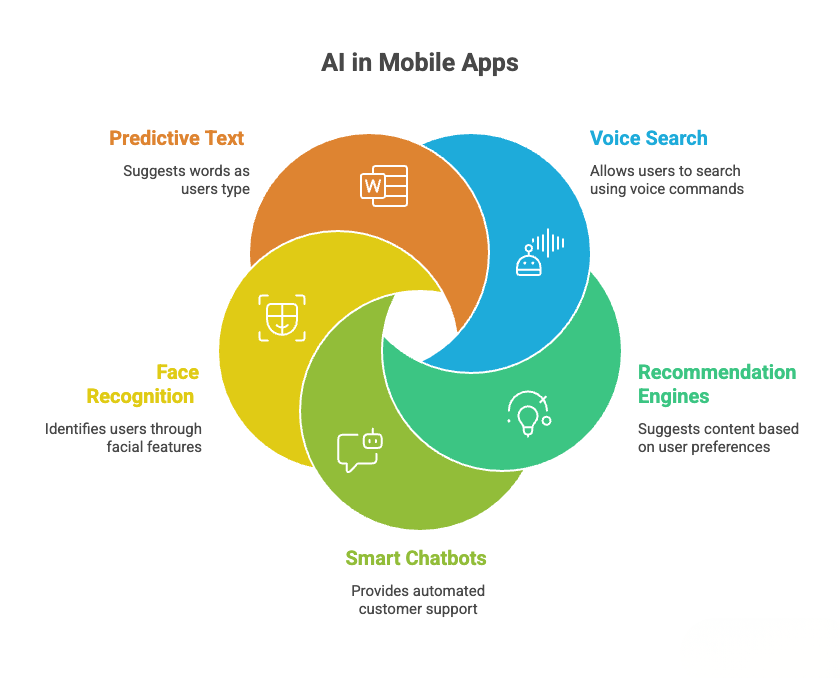
Voice Search and Speech Recognition
Installing and using voice assistants like Siri or Google Assistant has become commonplace with the advent of AI technologies for voice commands. Therefore, in terms of inclusivity and user convenience, the voice recognition capabilities of this AI in mobile app development are greatly enhanced by the navigation features, voice commands, and numerous accessible options.
Recommendation Engines
No matter if it’s Netflix or Amazon, the recommendation engines are now the backbone of content and product discovery. These engines utilize collaborative filtering and neural networks to provide the most relevant items to their users, which results in increased time spent on the app and ultimately better conversion rates.
Smart Chatbots and Virtual Agents
AI-driven chatbots can be utilized for customer support, lead qualifications, onboarding, and even more complicated troubleshooting. AI agents and chatbots offer support via NLP-driven bots, providing instant, automated answers to FAQs and guiding users through app interfaces.
Face and Object Recognition
AI in mobile app development identifies and deals with visual components in real time. Hence, it is used in biometric authentication (face/fingerprint scanning), photo tagging, and augmented reality (AR) virtual try-ons.
Predictive Text and Autocomplete
AI built into contemporary keyboards predicts what the user wants to type, fixes mistakes on its own, and occasionally even recommends emojis in place of words. These features improve usability and reduce user friction, particularly in email or messaging applications.
Core AI Technologies Driving Mobile App Development Services
Well, AI is not a single technology; it’s a mix of multiple tools and technologies working together to make mobile apps smarter, helpful, and more fun to use. So, below is a breakdown of key AI technologies that are changing the mobile app industry:
Machine Learning
Machine learning-powered mobile app development services let apps improve without the need to be told what to do. AI-powered apps with machine learning adapt by analyzing data. This even helps provide tailored recommendations and make forecasts based on user behavior. The more the application is used, the better it suggests. For example, Netflix recommends movies you might like based on the type of content you have watched.
Natural Language Processing
NLP helps mobile applications understand and respond to human queries. Popular voice assistants like Siri and Alexa utilize NLP to answer your queries. This makes conversation feel more natural and reduces a lot of the usual clunky interface stuff.
Computer Vision
Computer vision-integrated apps can see and understand images and videos. As a result, AI-powered mobile app development services can include cool features like facial recognition for unlocking phones, scanning documents, and identifying products in images.
This plays an essential role in AR (augmented reality) and VR (virtual reality) apps that help create immersive experiences for everything from online gaming to shopping.
Generative AI
Generative AI lets the app think and create new content, whether it’s text, images, or simple app layouts. Like Google’s Gemini models are already using this. Generative AI services offer endless possibilities—AI-created avatars, tailored in-game content, or even AI helping developers build features faster by creating UI mockups or app content on the fly.
Examples of AI in Mobile App Development
AI in mobile app development is no longer experimental. It is quietly powering everyday user experiences across industries.
Businesses investing in AI-powered mobile app development services are focusing on measurable impact, not novelty.
- Personalized commerce apps use AI to adjust product feeds based on browsing patterns and purchase history.
- Fintech applications apply machine learning to detect fraud in real time.
- Healthcare apps analyze symptom data to support early diagnosis insights.
- Logistics platforms optimize routes using predictive traffic intelligence.
- Customer support apps deploy NLP chatbots to handle high-volume queries efficiently.
Challenges of AI in Mobile App Development
AI adds intelligence to apps. It also adds layers of risk, cost, and complexity that businesses often underestimate.
When companies adopt AI in mobile app development without structural planning, execution gaps begin to show quickly.
Ethical Concerns
AI systems learn from data. If the data is flawed, the output is flawed too. Bias in training datasets can lead to unfair recommendations, inaccurate profiling, or exclusion of certain user groups. For industries like finance or healthcare, this becomes a serious credibility issue.
AI-powered mobile app development must include bias testing, explainability layers, and human review systems. Without these controls, automation can quietly damage brand trust.
Ethical design is no longer optional in modern mobile app development services. It is a competitive safeguard.
Data Privacy Errors
AI in mobile applications depends on user data. But excessive or careless data usage creates regulatory and reputational risk.
Poorly designed AI mobile app development architectures may collect more behavioral data than necessary. Some systems fail to encrypt data properly or lack structured consent management.
With stricter global privacy regulations emerging, privacy-first engineering is becoming a core requirement for any serious mobile app development company.
Data minimization, encrypted pipelines, and secure storage are not technical extras. Rather, they are business protection mechanisms.
Technical Issues
Traditional mobile app development rarely deals with real-time model inference, retraining pipelines, and distributed computing layers.
Heavy AI models can slow app performance if not optimized properly. Latency issues directly impact user experience and retention.
Infrastructure costs can also rise unexpectedly. Continuous training and cloud processing demand scalable backend systems.
This is where experienced mobile app development services matter. AI integration requires alignment between mobile engineers, data scientists, and DevOps teams from day one.
Regulatory and Legal Issues
AI governance is tightening globally. Businesses can no longer deploy AI-driven features without documentation and compliance planning.
High-risk AI applications in finance, healthcare, or hiring must provide transparency into automated decisions. Some regions require audit trails and human override capabilities.
An AI-powered development company must build compliance architecture into the product lifecycle, not bolt it on later.
Ignoring regulation may delay launches, attract penalties, or restrict market access. Planning for compliance early reduces long-term friction.
Future of AI Mobile App Development
AI-Powered Voice & Gesture Recognition
As artificial intelligence is getting better and better, apps are no longer limited to speech recognition. They can also recognize gestures. All this makes it possible to have touchless interactions.
Real-Time Translation and Localization
The globalization of businesses has made it crucial to have real-time translations of languages. AI in mobile applications can identify the end user’s language and the content. This way, you can increase user interactions. AI-powered mobile applications are suitable for global users.
Emotion Detection for Deeper User Interaction
Businesses can incorporate emotion recognition based on text input, voice tones, or facial expressions using machine learning in apps. These characteristics lend compassion to AI in mobile app development, making it appropriate for applications related to gaming, customer service, and mental health.
Advanced AI Analytics Dashboards
In the near future, AI-powered mobile app development will include smarter analytics embedded into the app interface. These dashboards will offer predictions, behavioral analysis, and forecast performance. The utilization of these helps you make informed decisions in mobile app development.
Conclusion
Artificial intelligence is bringing innovation to mobile app development services and making waves. And as it advances, user interactions with apps and services are going to change and become more personalized.
Businesses that are adopting AI are not just building apps. Rather, they are creating innovative digital ecosystems. And with a reliable mobile app development company like CodingWorkX, businesses can deliver exceptional user experiences. Whether it’s custom mobile app development or AI development, we build unique solutions for users across the globe. We are committed to delivering custom solutions while sticking to data privacy and industry standards.
Connect with us now and let us create robust AI apps for you.