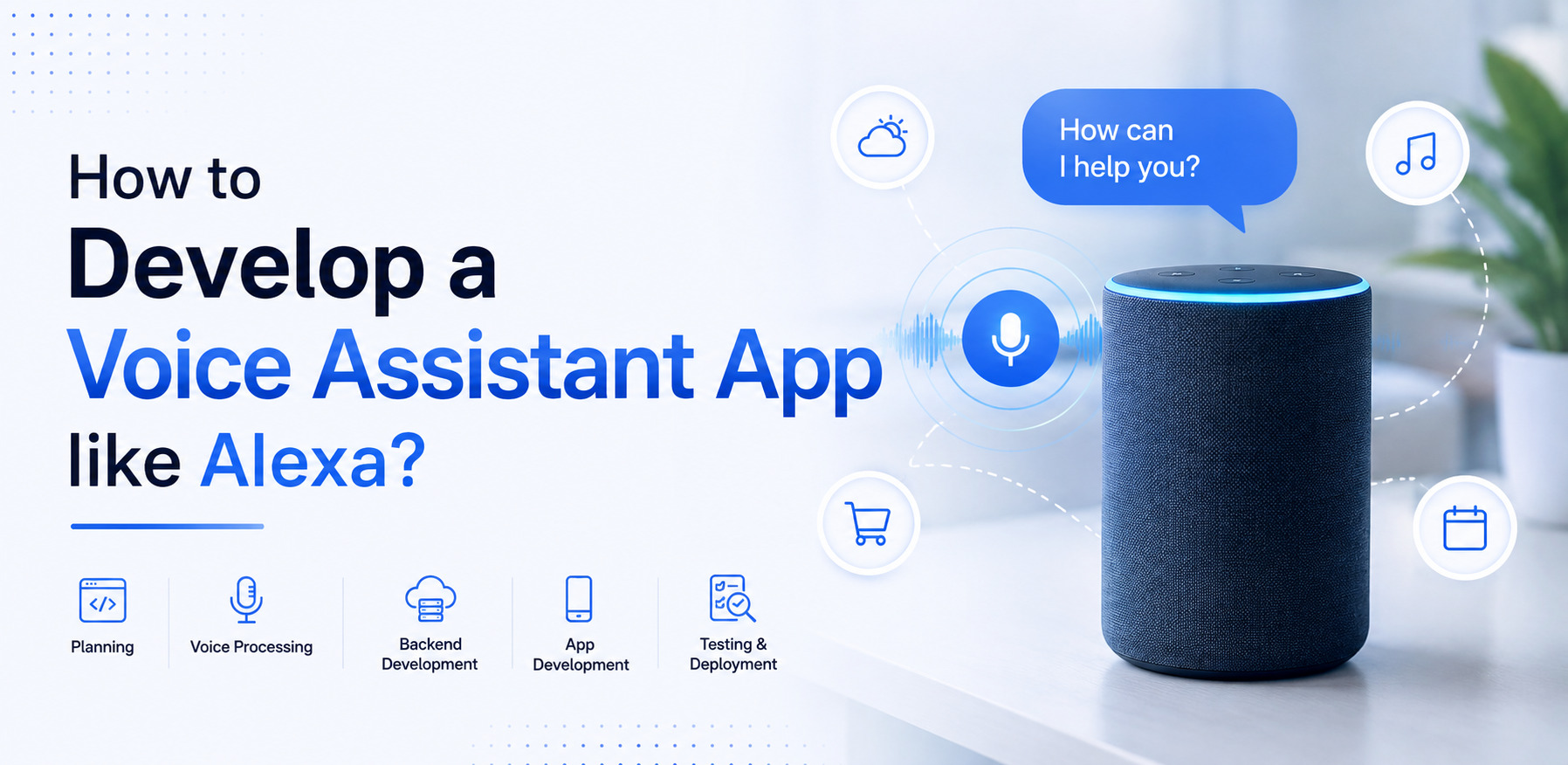
Just imagine it’s early morning; you are sipping your coffee while saying, “Alexa, what’s the weather update?” Follow up with “Play my playlist,” and your favorite songs start tuning. That’s the power of virtual assistants like Alexa. They perform your daily tasks smoothly and offer unparalleled convenience.
Increased automation in businesses and the growing ease of use of daily applications have led to a boom in AI voice assistant development. These solutions, often powered by Natural Language Processing (NLP), are now transforming customer experience across industries.
The global Voice Assistant Market is expected to reach USD 33.74 billion by 2030. As that opportunity grows, more businesses are asking the same question: how to make an AI voice assistant that actually works for their use case. This guide walks through what a voice assistant is, its features, its tech stack, and the full AI voice assistant development process.
What is Voice Assistant Solution?
A voice assistant app interacts with individuals and mimics real-life human conversations through web, mobile, or desktop apps. These voice assistant solutions leverage AI, speech recognition, and NLP to understand and execute user commands via voice. Virtual assistants like Alexa perform tasks like controlling home appliances, building shopping lists, and answering user queries and by learning from user interactions, they continually improve their conversational capabilities.
Types of Voice Assistants
Here is a brief breakdown of voice assistant solution types and their roles:
Voice Assistants
It is widely used for everyday tasks like weather updates, controlling smart devices, etc. For example, Alexa handles smart home control, Siri can seamlessly integrate with Apple services, and Google Assistant helps in search.
Chatbot
These were initially text-based but now incorporate voice interactions for real-time customer support. For example, ChatGPT combines text and voice capabilities for better responses. Also, businesses can build tailored virtual assistants.
AI Avatars
These combine voice and visuals for immersive responses. NVIDIA AI Avatars, for instance, are now used in gaming, virtual events, and training. These voice assistant solutions are changing how we interact with technology and offer more intuitive digital experiences.
What are the Advantages of AI Voice Assistant Development?
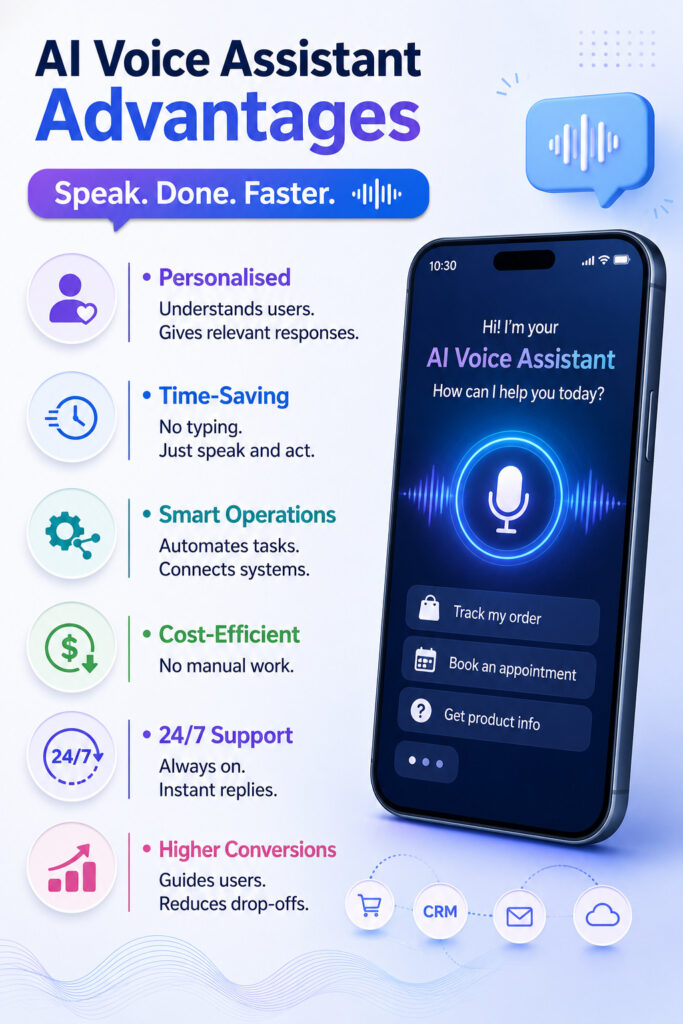
With rising user expectations, technology is shifting toward voice and speech recognition. Typing is no longer the fastest way to engage people want to speak, get instant responses, and move on. This shift is exactly where AI voice assistant development starts to create real business value, changing how customers interact, how teams operate, and how quickly decisions happen.
Tailored Experience Modern voice assistant solutions don’t just respond, they learn. Over time, they understand user preferences, behavior patterns, and intent, enabling businesses to deliver more relevant responses and contextual interactions. Virtual assistants like Alexa can adjust outputs based on past usage, location, or time of day. A level of personalization that’s hard to achieve through traditional interfaces.
Saves Time & Effort Voice removes friction. There’s no need to navigate menus, type queries, or switch between screens. Users can complete tasks instantly, whether searching for information, placing an order, or controlling a device. Internally, teams also save time by automating repetitive actions.
Enhanced Operations Behind the interface, voice assistants streamline operations in ways that are often underestimated. They can automate workflows, trigger backend processes, and integrate with systems like CRMs or ERPs. Businesses exploring how to make an AI voice assistant often realize the operational impact is just as valuable as the customer-facing side.
Decreased Costs Automation through voice reduces dependency on large support teams and repetitive manual work. Instead of scaling human resources for every increase in demand, businesses can rely on AI-driven assistants to handle routine queries such as lowering operational costs while maintaining consistent service quality.
Why are Voice Assistant Solutions Getting Popular?
AI voice assistants like Alexa and Siri are now an integral part of modern living, managing smart devices and retrieving real-time information. Here’s what’s driving the popularity of these voice assistant solutions:
Rising Adoption
About 58% of consumers use voice search for their daily tasks with interactions.
Accuracy
Voice searches offBetter Customer Service
Speed and availability define good support today. And voice assistants deliver both.
They offer 24/7 assistance, instant responses, and consistent communication. They can answer FAQs or guide users through processes; voice-based interactions feel more natural and less transactional. This results in overall customer satisfaction without increasing support load.
Boost Business Recovery Rates
One often overlooked benefit is how voice can reduce drop-offs.
Users who abandon processes due to complexity or delays can be re-engaged through simple voice prompts or guided interactions. Whether it’s completing a purchase, resolving an issue, or finishing a form, voice assistants help bring users back into the flow. That directly improves conversion and recovery rates.
er more accurate responses, as 70% of voice queries are phrased as a complete question.
Market Growth
The global speech and voice recognition market is going to hit USD 23.11 billion by 2030. And this growth is fueled by advancements in NLP and AI.
Advanced Technology
AI and NLP enable context-aware, human-like interactions, bridging the gap between users and machines.
Versatile Application
Regardless of whether it is a smart home device or customer service, AI voice assistants help streamline tasks and improve overall efficiency.
Top Features To Include In Your Voice Assistant Solutions
The difference between a basic tool and a reliable assistant comes down to features. When businesses invest in AI voice assistant development, the focus shouldn’t just be on voice commands. It should be on how intelligently the system understands, responds, and adapts over time.
Here are the features to include:
Automatic Speech Recognition
The assistant must accurately convert spoken words into text, even with different accents, speeds, or background noise.
Poor recognition breaks trust instantly. Strong ASR ensures that users don’t have to repeat themselves, which is critical for adoption.
Customization
No two businesses use voice the same way.
Your assistant should allow custom commands, workflows, and responses aligned with your domain. Whether it’s healthcare, retail, or logistics, tailored behavior makes the assistant feel relevant rather than generic.
Task Automation
Goes beyond answering queries to taking action, from booking appointments to triggering internal workflows. This is often the turning point when businesses explore how to make an AI voice assistant move from idea to real ROI.
Multi-Functional Capabilities
Handles multiple tasks seamlessly. Just like virtual assistants like Alexa, a well-built system manages everything from information retrieval to device control without friction.
Smart Home Integration
Controlling lights, appliances, or security systems through voice creates a connected experience. Even for enterprise use cases, similar integrations can extend to smart offices or industrial systems.
Multilingual Support
Your assistant should understand and respond in multiple languages or dialects, especially in diverse markets. This feature directly impacts usability and adoption across regions.
Query Handling
Not every query will be clear or complete.
A good assistant can manage incomplete inputs, ask follow-up questions, and still guide users toward a resolution. This requires a solid combination of NLP and contextual understanding.
Privacy and Security
Strong encryption, secure storage, and clear consent mechanisms are non-negotiable. Users need to trust that their conversations are handled responsibly. Ongoing support and monitoring also ensure the system stays reliable after deployment.
Accessibility Features
Features like speech-to-text support, adjustable voice speeds, and compatibility with assistive technologies make the system more inclusive. Accessibility is often overlooked, but it directly improves user experience.
Wake Word Detection
Accurate wake word detection prevents false triggers while ensuring a quick response when users call it. This balance is essential for both usability and privacy.
Location-Based Services
By using location data (with consent), assistants can provide more relevant responses, whether it’s nearby services, weather updates, or navigation. This way, interactions become more practical.
Reminder Integration
Setting reminders, alerts, or follow-ups through voice adds convenience and increases daily usage.
Language Transmission
Beyond understanding, your AI voice assistant should be able to translate or relay information across languages. It is beneficial for global businesses or customer-facing platforms where users may speak different languages.
How to Make an AI Voice Assistant Like Alexa?
Building a virtual assistant like Alexa or Siri requires deep technical knowledge and a cutting-edge tech stack. These apps integrate AI, NLP, and ML to offer smooth, intuitive voice interactions.
Here’s the step-by-step process for AI voice assistant development:
Define Your AI Assistant’s Core Purpose
The first step is to define the core objective of your voice assistant, like what problem it is going to solve. Or will it specialize in a specific niche like healthcare, etc.? Ultimately, having a focused purpose helps ensure your solution meets user expectations.
Choose the Right Tech Stack
Successful AI voice assistant development relies on a combination of technologies. Conversational AI sits at the forefront of enabling machines to imitate human intelligence and make decisions from data, while machine learning drives continuous performance improvement. If you want to connect your assistant to smart appliances or speakers, it should also integrate IoT for seamless data transfer. Here’s a breakdown of the core technologies used for building virtual assistants like Alexa:
- Natural Language Processing: Processes user input to identify intent and context, enabling the assistant to understand commands and generate appropriate responses.
- Text-to-Speech (TTS) Engine: Converts processed text into voice output for a natural, human-like response.
- Intelligent Tagging and Decision-Making: Maps user inputs to predefined intents and actions, determining how the system responds.
- Voice/Speech-to-Text Engine: Converts spoken input into text as the first layer of voice command recognition.
- Noise Reduction Engine: Filters background noise to improve real-time recognition accuracy.
- Voice User Interface: Defines how users interact with the system through voice and manages conversation flow.
- Voice Biometrics: Authenticates users based on voice patterns, enhancing security and preventing unauthorized access.
- Cloud Services: Provides the processing power, storage, and scalability needed for real-time responses.
Determine AI Voice Assistant’s Features
Decide on features like automation, multilingual support, and integrations early. This avoids rework later and keeps development efficient, especially when scaling toward systems similar to virtual assistants like Alexa.
Collect and Preprocess Data
Data is vital for accuracy in voice assistants. Collect large datasets of conversational inputs, commands, and user intents. And if your app serves a specific industry, it should collect domain-specific data. Also, raw data often creates inconsistencies. So clean and preprocess it to improve both accuracy and efficiency. By using techniques like data labeling and filtering, businesses can ensure that their model concentrates on meaningful inputs.
Train Your Voice Assistant Solutions
Businesses should use advanced machine learning models to train virtual assistants on how to recognize speech, understand context, and respond accurately. Also, with tools like TensorFlow, Extended can streamline the training process.
Pick a Method to Integrate a Voice Assistant
- Basic Integration (Good Bots) — Incorporates voice technology within your app through APIs and a development kit. Google Dialogflow and Microsoft Bot Framework provide libraries, services, and tools that help developers build intelligent bots, which can then be exported to Alexa or Google.
- Custom Development (Expert Bots) — Your development team uses APIs and open-source tools like Jasper to build a virtual assistant like Alexa. Rasa, a conversational AI framework, can also be used to create text and voice-based assistants with more flexibility and custom coding. These can be deployed on your own system or in the cloud.
- Simplified Bots (Basic Bots) — Used for smaller requirements where defined paths and responses are enough, without needing advanced language understanding. The key here is asking the right questions to map out routes for new conversations tailored to your business needs.
Depending on your app’s objectives, choose the method that best fits your expectations. Building a voice assistant like Alexa is a genuinely challenging undertaking, so it’s often worth partnering with a reliable AI development company to navigate the complexity.
Test Comprehensively
Voice assistants must be tested across accents, environments, and edge cases. This includes speech recognition accuracy, response timing, and handling incomplete queries. Consistent testing ensures the assistant performs reliably in real-world scenarios.
Support and Maintenance
AI systems need continuous monitoring, updates, and retraining as user behavior changes. Ongoing support keeps your voice assistant solutions accurate, secure, and relevant over time.
How Much Does It Cost to Build An AI Voice Assistant?
Cost is a major factor for any business figuring out how to make an AI voice assistant. The total investment depends on features, complexity, and the level of intelligence you want to achieve.
- Basic assistant (simple commands, limited functionality): $30,000–$55,000
- Mid-level assistant (NLP, integrations, multilingual support): $55,000–$120,000
- Advanced assistant (similar to virtual assistants like Alexa, with AI training, IoT integrations, and scalable infrastructure): $120,000+
The final cost varies based on your use case, tech stack, and how deeply the assistant integrates into your business systems.
Build a Voice Assistant like Alexa With CodingWorkx
We at CodingWorkX hold years of expertise and have successfully assisted businesses in different verticals in developing and deploying innovative digital solutions. We are not just a mobile app development company; we are your long-term partner who creates robust voice assistant solutions to transform user experience. CodingWorkX caters to the unique requirements of its clients and delivers immersive and feature-rich voice assistants. Contact us now and unlock the potential of your voice assistant app idea.
Conclusion
Building a virtual assistant like Alexa takes effort, leading-edge technology, thoughtful design, and a strong focus on user requirements. Success depends on defining the app’s purpose, choosing the right tech stack, and prioritizing privacy. Your voice assistant solutions should include features like task automation and customization from day one. If you’re ready to move from researching how to make an AI voice assistant to actually building one, partner with CodingWorkX.
FAQs
What are AI voice assistants used for?
Voice assistant solutions often carry out multiple tasks daily by utilizing AI and ML and offer custom responses. Virtual assistants like Alexa run on smart speakers, smartwatches, mobile phones, and tablets. These can be used for many purposes, like hands-free operations, automation, smart home control, navigation and direction, language translation, shopping, providing weather news and updates, and sports scores.
How much does it cost to build a virtual assistant like Alexa?
The total cost of developing an AI assistant app like Alexa can fluctuate depending on different factors. However, the cost of a basic assistant will range somewhere between $30,000 and $55,000 for simple commands and functionalities. A mid-level assistant will cost you anywhere from $55,000 to $125,000. These include features like IoT integration and multi-language support.
Can voice assistant solutions be integrated into existing software solutions?
Yes. We can seamlessly integrate AI voice assistants with your existing software, like CRMs, ERPs, and other systems. These automate workflows, enhance efficiency, and centralize data without overwhelming your current setup.
How much time does it take to develop an AI voice assistant?
The timeline varies depending on project complexities and features. And a basic assistant takes 3 to 6 months, a mid-level assistant takes somewhere between 6 and 12 months, and a complex assistant with advanced features will take more than 12 months.
Which are the most popular voice assistant solutions?
Different tech giants have their own AI voice assistants, like Amazon’s Alexa, Apple’s Siri, and Google’s voice assistants. All of these are popular for their unique features. However, Amazon’s Alexa is available on 60,000 devices and linked to 100 million devices.