Choosing the right mobile app development frameworks is one of the most important decisions a business makes before writing a single line of code. The global mobile app market is forecasted to hit USD 626.39 billion by the end of 2030, and businesses are racing to build apps that stand out. But a great app idea means little without the right mobile app development tools and framework behind it.
With so many mobile app development frameworks available today from cross-platform options to fully native stacks deciding on one gets harder every year.
In this guide, we’ll walk through the best mobile app development tools, compare leading app development technologies, and break down the mobile app development trends shaping framework selection in 2026.
What are Mobile App Development Frameworks?
Mobile app development frameworks are not just coding libraries. They define how your app is built, how fast it ships, and how well it scales. A framework provides reusable components, APIs, and mobile app development tools that simplify the entire build process.
The right framework decides:
- How much code you can reuse across platforms
- How your app performs in real-world conditions
- How expensive long-term maintenance becomes
Choosing between competing app development technologies isn’t just a technical step. It’s a product decision that affects your budget, timeline, and user experience for years.
List of Top Mobile App Development Frameworks
Here are the best mobile app frameworks businesses are using in 2026:
Flutter (Performance + UI Control)
Flutter is one of the fastest-growing cross-platform app development frameworks available today. It compiles to native code and uses its own rendering engine, meaning fewer dependencies on platform UI components and more control over design.
Where Flutter works best:
- Custom UI-heavy apps
- MVPs that need fast iteration
- Products targeting both iOS and Android from day one
React Native
React Native remains one of the best mobile app frameworks for a reason. It uses native components connected through a JavaScript bridge flexible, though slightly less performant in complex scenarios.
Where it works best:
- Apps that evolve frequently
- Teams with web development experience
- Products that rely on third-party integrations
SwiftUI (iOS Native)
For businesses building only for Apple users, SwiftUI is among the top mobile app development frameworks for deep iOS integration and smooth performance. This is where native vs. cross-platform frameworks becomes a real decision: native wins in performance-critical use cases.
Best for: premium iOS apps, apps requiring deep hardware integration, high-performance consumer products.
SwiftUI is best for:
- Premium iOS apps
- Apps requiring deep hardware integration
- High-performance consumer products
Jetpack Compose (Android Native)
This framework simplifies Android UI development, removing boilerplate while keeping full native performance that is ideal for Android-first markets and apps that need consistent performance.
Where it works best:
- Android-first markets
- Apps needing strong performance consistency
Ionic
Ionic falls into the hybrid app development frameworks category, using web technologies wrapped into a mobile shell. It’s faster to build, though performance depends on WebView.
Where it works best:
- Lightweight apps
- Dashboard or content-driven apps
- Rapid prototyping
Kotlin
Kotlin is one of the most important app development technologies in the mobile ecosystem today. Google has made it the preferred language for Android development, but what makes Kotlin stand out in 2026 is Kotlin Multiplatform. Allowing developers to share code across Android, iOS, web, and desktop while keeping native performance.
This shifts the entire native vs cross-platform frameworks conversation. Developers can:
- share business logic across platforms
- keep native UI where needed
- avoid performance trade-offs seen in traditional cross-platform frameworks
.NET MAUI / Xamarin (Enterprise Stack)
These cross-platform app development frameworks are widely used in enterprise ecosystems, offering shared codebases with structured architecture, especially useful for businesses already on Microsoft technologies.
Where it works best:
- Enterprise applications
- Internal systems
- Scalable business apps
Brief Comparison of Mobile App Development Frameworks
Below is a practical comparison of mobile app development frameworks based on performance, architecture, and real-world use cases:
| Parameter | Flutter | React Native | Ionic | Swift/Kotlin | .NET MAUI |
| Type | Cross-platform | Cross-platform | hybrid | Native | Cross-platform |
| Programming Language | Dart | JavaScript | HTML, CSS, JS | Swift/Kotlin | C# |
| Performance | High (near-native) | Moderate–High | Moderate (WebView-based) | Very High | High |
| Rendering Approach | Own rendering engine | Native bridge | WebView | Native UI | Native UI abstraction |
| Code Reusability | High | High | Very High | Low | High |
| Development Speed | Fast | Fast | Very Fast | Slower | Moderate |
| UI Flexibility | Excellent | Good | Limited | Excellent | Good |
| Scalability | High | High | Medium | Very High | High |
| Best Use Case | MVPs, startups, rich UI apps | Scalable apps, frequent updates | Simple apps, dashboard | Performance-heavy apps | Enterprise apps |
| Learning Curve | Moderate | Low–Moderate | Low | High | Moderate |
Essential Mobile App Development Tools to Pair With Your Framework
A framework alone doesn’t ship an app. The right mobile app development tools around it determine how smoothly your team builds, tests, and deploys. In 2026, teams commonly pair their chosen framework with:
- CI/CD platforms (GitHub Actions, Bitrise, Fastlane) to automate builds and releases
- State management and debugging tools (Redux DevTools, Flutter DevTools) to speed up iteration
- Testing frameworks (Appium, Detox, XCTest) to catch issues before launch
- Design-to-code tools (Figma plugins, Zeplin) to keep UI implementation consistent
- Analytics and crash-reporting tools (Firebase, Sentry) to monitor performance post-launch
Picking the right combination of mobile app development tools alongside your framework is often what separates a smooth build from a stalled one. This is an area where working with an experienced mobile app development company pays off, since they already know which tools pair well with which frameworks.
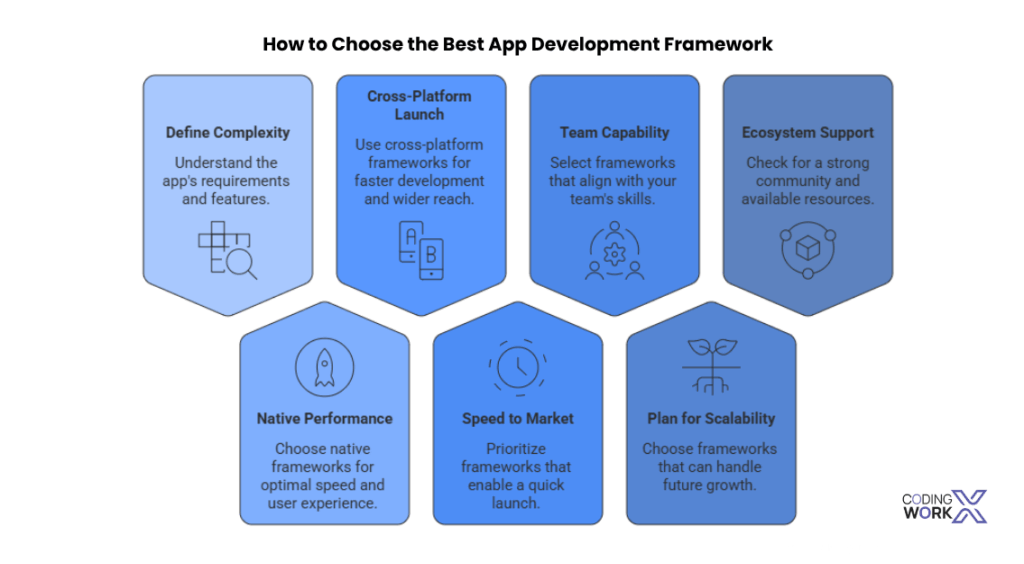
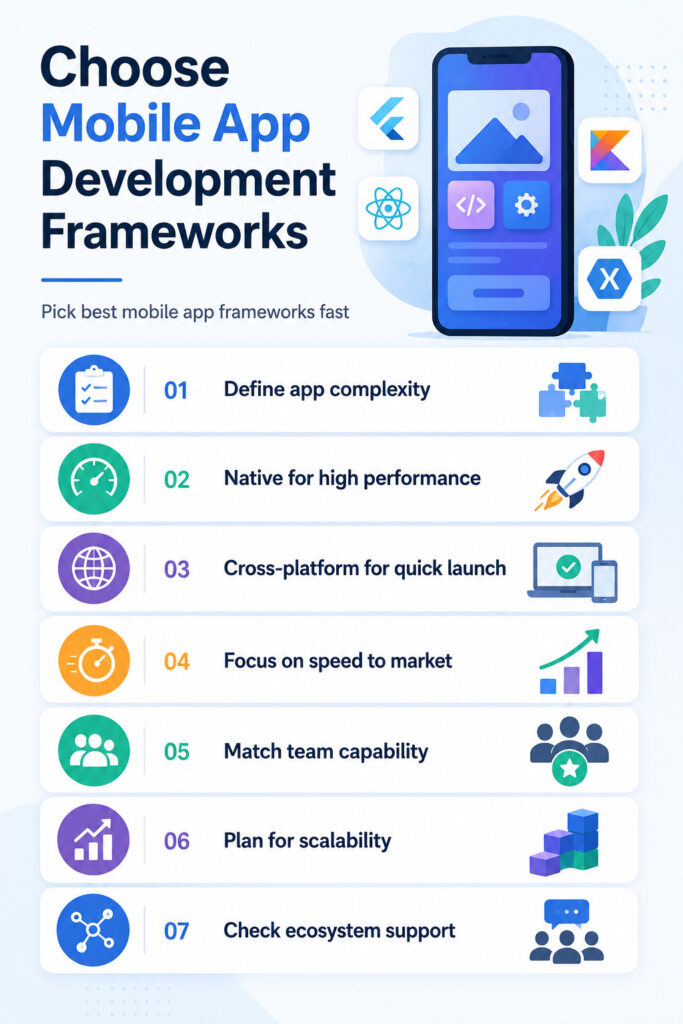
How To Choose Top App Development Frameworks in 2026?
Picking the best mobile app frameworks can help your business grow faster. Also, it is advisable to take the help of a reliable mobile app development company to decide. Here are practical steps to help you pick the right one as per your business requirements.
1. Product Complexity
If your app depends heavily on device features or real-time processing, native is safer. If not, cross-platform app development frameworks can reduce effort significantly.
2. Speed to Market
If timing matters, frameworks like Flutter or React Native help launch faster. That’s why startups lean toward them.
3. Team Capability
Framework choice should match your team’s skills. Choosing the “best” framework that your team can’t execute properly is a common mistake.
4. Long-Term Scalability
This is where decisions break later. Frameworks that work for MVPs don’t always work at scale. Planning in advance is important.
5. Ecosystem & Support
Strong ecosystems reduce development friction. This is why React Native continues to stay relevant among mobile app development tools.
How Do Mobile App Frameworks Influence the Development Process?
Your chosen mobile app development frameworks and mobile app development tools shape every stage of development:
- Speed: Flutter-based cross-platform development speeds up delivery.
- Cost: Reusable components lower overall app development cost.
- Performance: Native frameworks excel at device-specific features.
- Maintenance: Shared codebases and modular design patterns simplify long-term upkeep.
Even frontend frameworks for mobile apps influence UI consistency and responsiveness. The framework isn’t just a tool, it’s the foundation of your entire development process.
Mobile App Development Trends Shaping Framework Selection
Mobile app development framework decisions are now driven by mobile app development trends, not just developer preference. Here’s what’s actually changing:
AI Integration
AI-powered apps are now becoming a standard. AI integrations improve customized recommendations, user engagement, and overall functionality. Therefore, to stay competitive, businesses must collaborate with a reliable AI app development company to embed machine learning and smart automation into mobile apps.
Low Code/No Code
Now, low-code or no-code platforms are becoming popular for building tools and MVPs faster. These offer a cost-effective solution for rapid application development with minimum technical expertise.
Unified Development
Businesses want apps that run across mobile, web, and desktop, pushing wider adoption of cross-platform app development frameworks.
Performance Optimization
Users expect fast apps, pushing teams back toward lightweight, optimized mobile app development tools.
Conclusion
Choosing the right mobile app development frameworks in 2026 comes down to aligning your framework and mobile app development tools with your product’s complexity, your team’s strengths, and your long-term scalability goals. Whether you pick a native framework for performance or a cross-platform framework for faster delivery, the best choice is the one your team can execute well and maintain long-term.
Working with a trusted and experienced mobile app development company helps businesses choose the right tech stack and build future-ready mobile apps that offer real value to end users. Therefore, you need expert guidance; contact us and discuss your unique business requirements.
FAQs
What are the key features to look for in mobile app development frameworks?
Look for hot reload, native API access, modular architecture, strong documentation, scalability, and ease of integration with other mobile app development tools.
How can I choose the best mobile app frameworks?
Consider product requirements, target platform (iOS, Android, or both), and your team’s experience before deciding.
What’s the difference between hybrid and native mobile app development frameworks?
Native frameworks deliver better performance and deeper integration. Hybrid app development frameworks offer faster builds using web technologies but may trade off some performance.
Which are the best hybrid app development frameworks?
Ionic is among the top hybrid app development frameworks, widely used for lightweight apps and rapid builds.
What are the advantages of choosing cross-platform app development frameworks?
A single codebase across platforms reduces development time and cost while maintaining strong performance and a near-native UI.
Which framework is best for enterprise app development?
.NET MAUI, Flutter, and React Native are the most commonly used mobile app development frameworks for scalable enterprise solutions.
What mobile app development trends are influencing framework selection in 2026?
AI integration, unified development, low-code platforms, performance optimization, and server-driven UI are the top mobile app development trends shaping framework choice this year.