Running a restaurant is not enough today. Rather, restaurant owners need to ensure orders sync perfectly, inventory never runs out mid-shift, and their team spends less time fixing problems and more time delighting customers. This makes it vital to invest in restaurant management software development. It is because a connected system brings operations, data and decision-making at one place. So, teams don’t waste time fixing gaps and rather focus on offering better service.
Furthermore, as per recent reports, the restaurant management software market is growing fast and expected to hit USD 14.70 million by the end of 2030. Also, about 80% of restaurants already use advanced POS systems to manage orders and sales. These stats clearly show how digital tools are changing the restaurant industry.
However, as the operations become more complex with online orders, multiple locations, and data from different sources, a one-size-fits-all solution often falls short. That’s where having a reputable restaurant management software development partner can help. Also, our blog will walk you through everything related to restaurant management software, clear steps to build, cost estimations, etc. so you can make smart decisions.
What Is Restaurant Management Software?
Restaurant management software is a system that helps restaurants run their daily operations in one place. In simple terms, it connects key activities—orders, inventory, staff, and reports—so owners and managers can see what’s happening across the business without juggling multiple tools.
It works as a backbone that keeps restaurant operations organized, visible, and easier to control.
What Problems Does It Solve?
As restaurants grow, everyday tasks become harder to manage manually or with disconnected software.
Restaurant management software helps solve:
- Order handling across dine-in, takeaway, and online platforms
- Inventory tracking to reduce waste and stock shortages
- Staff scheduling and labor cost management
- Sales, performance, and operational reporting
- Lack of real-time visibility across locations
Instead of reacting to problems, teams can plan ahead using accurate data.
Generic Software vs. Custom-Built Software
Every restaurant works in different ways.
Generic restaurant software:
- Designed for broad use cases
- Limited flexibility and fixed features
- Often forces restaurants to change their workflows
- Can struggle with scaling and complex operations
Custom-built restaurant management software:
- Designed around your exact workflows
- Adapts to multi-location and hybrid business models
- Integrates smoothly with existing tools
- Scales as your restaurant grows
This is where custom restaurant management software becomes critical.
Every restaurant operates differently. Some focus on delivery, others on fine dining, franchises, or cloud kitchens. Customization ensures the software supports these unique models instead of restricting them.
Working with a custom-built software provider like CodingWorkX allows restaurants to build systems that fit their operations today and evolve with future growth without the limitations of one-size-fits-all solutions.
When Does a Business Need Custom Restaurant Management Software?
Not every restaurant needs custom software early on. But there’s a clear stage where ready-made tools stop supporting growth and start slowing the business down. This usually happens when operations become more layered and harder to control with generic systems.
Signs Your Business Has Outgrown Standard Tools
Most restaurant owners notice the cracks before they see the cause.
Common signs include:
- Managing multiple locations with inconsistent data and reports
- Running franchise operations with varying rules and approval flows
- Handling high order volumes across POS, online platforms, and aggregators
- Depending on spreadsheets due to gaps in restaurant POS billing software
- Struggling with disconnected inventory, kitchen, and staff data
At this stage, even basic updates take more time than they should.
Operational Risks of Staying with Disconnected Systems
Continuing with fragmented tools may seem manageable, but the risks add up quietly.
These challenges often include:
- Limited visibility into real-time sales and stock
- Errors between front-of-house and restaurant kitchen management software
- Delayed decisions due to manual reporting
- Difficulty scaling quick service or delivery-focused models
Over time, these issues affect margins, customer experience, and team productivity.
When Custom Software Becomes the Smarter Choice
This is where restaurant management software development becomes relevant. Instead of forcing your business to adjust to fixed features, a custom-built system adapts to your workflows, order volume, and operating model—whether you run a fine-dining setup, cloud kitchen, or quick service restaurant management software environment.
At this point, custom software should be seen as a long-term investment. It reduces operational friction, improves data accuracy, and supports growth without constant workarounds. Rather than paying the ongoing cost of inefficiency, businesses gain a system designed to grow with them.
Key Features of Custom Restaurant Management Software
The value of custom-built systems doesn’t come from having more features. It comes from having the right ones—designed around how your restaurant actually operates. Instead of forcing teams to adjust, the software adjusts to the business.
Below are the core restaurant management software features that matter most when the system is built for real-world use.
Order & Sales Management
Orders move fast. The system managing them needs to keep up without creating confusion.
A custom setup allows:
- Centralized order tracking across dine-in, takeaway, and delivery
- Smooth handling of peak hours without data delays
- Real-time sales visibility for owners and managers
With everything flowing through one system, sales data stays accurate and easy to monitor.
Inventory & Supplier Management
Inventory issues rarely come from lack of effort—usually from lack of visibility.
Custom inventory workflows support:
- Automatic stock updates as orders are processed
- Low-stock alerts before shortages affect service
- Better food waste control and tighter cost management
This makes inventory predictable instead of reactive, even for high-volume kitchens.
Staff & Shift Management
People operations are just as important as food operations.
Custom staff modules help with:
- Flexible employee scheduling based on demand
- Attendance tracking without manual follow-ups
- Role-based access to improve accountability
When responsibilities are clear, teams perform better and managers spend less time fixing gaps.
Billing, Payments & POS Integration
Billing should feel invisible to customers and effortless for staff.
Custom billing flows support:
- A seamless checkout experience
- Multiple payment options without reconciliation issues
- Integration with existing restaurant POS billing software
This avoids system clashes and keeps financial data consistent.
Customer Data & Loyalty Management
Repeat business is driven by understanding customers, not guessing.
Custom systems make it easier to manage:
- Customer order history across channels
- Loyalty programs tailored to your business model
- Personalized offers that feel relevant, not generic
This is especially valuable for quick service and delivery-first restaurants.
Reports & Business Insights
Data only matters when it’s easy to read and act on.
Custom reporting provides:
- Daily, weekly, and monthly performance reports
- Clear dashboards built for non-technical decision-makers
- Faster insights without manual data pulls
Instead of digging through spreadsheets, leaders see exactly what’s working—and what needs attention.
When designed thoughtfully, custom restaurant systems don’t feel complex. They feel natural. The software works in the background, while teams focus on service, consistency, and growth.
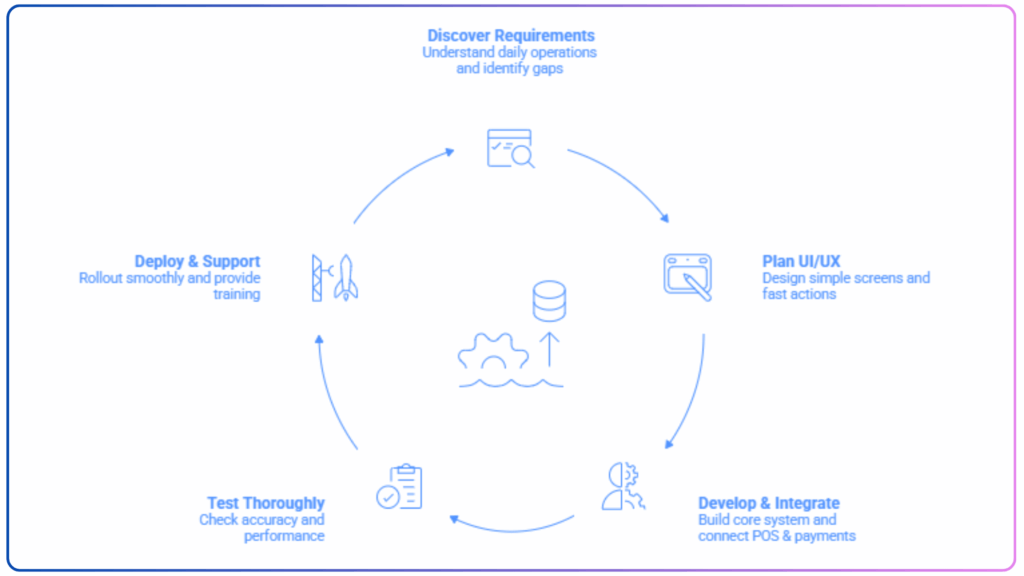
The Step-by-Step Process to Build Custom Restaurant Management Software
For many restaurant owners, custom software can feel risky or overwhelming. In reality, the process is structured, collaborative, and designed to reduce disruption—not create it. When done right, each step builds clarity and confidence.
Business Requirement Discovery
Everything starts with understanding how your restaurant actually runs.
This phase focuses on:
- Mapping daily workflows across orders, kitchen, inventory, and staff
- Identifying gaps, delays, and manual work in current systems
- Aligning software goals with real business outcomes, not assumptions
The aim is simple: build software around the business, not the other way around.
UI/UX Planning for Restaurant Staff
If the system is hard to use, it won’t be used well, no matter how powerful it is.
UI and UX planning prioritizes:
- Simple, clutter-free screens
- Fast actions for busy service hours
- Minimal training for new and existing staff
The result is a system that feels intuitive, even during peak rush.
Software Development & Integration
Once the foundation is clear, development begins.
This stage typically includes:
- Backend development to handle data, logic, and performance
- Integrations with POS systems, payment gateways, and delivery platforms
- Secure data flow between all connected tools
Everything is built to work together without breaking existing operations.
Testing & Quality Assurance
Before launch, the software is tested in real-world scenarios.
This ensures:
- Accuracy in billing, inventory tracking, and reports
- Stable performance during peak hours and high order volumes
- Early detection of edge cases that could disrupt service
Testing reduces surprises after rollout.
Deployment, Training & Support
Launch isn’t the finish line—it’s the starting point.
A smooth deployment includes:
- Phased rollout to avoid operational disruption
- Staff onboarding with clear guidance
- Reliable ongoing support and updates through software maintenance and support services
With the right support in place, the system continues to improve as the business grows.
How Much Does It Cost to Build Restaurant Management Software?
Just like the type of restaurant management software varies. Therefore, it’s essential for businesses to have a clear understanding of the budget involved. This helps you avoid unexpected surprises and hidden costs that may pop up later. Also, the hotel restaurant management software cost varies depending on multiple factors like size, number of features, functionalities, development team location and more. On an average, a basic app with simple functionalities will cost you somewhere between $25,000 to $80,000. On the other hand, a complex app with multiple features will cost you $300,000 or more.
Additionally, it’s not just the final investment. You need to set apart about 15% to 25% of initial investment for continuous maintenance and support. Below is a brief cost breakdown:
| App Type | Cost Involved | Features |
| Basic System | $25,000 – $80,000 | Simple reporting, inventory tracking |
| Growing Chain Solution | $80,000 – $200,000 | Multi-location management, advanced reporting, API integrations |
| Enterprise Solutions | $200,000 – $300,000 | Advanced AI features, custom integrations, enterprise-grade security |
Note: Costs can enhance when you integrate more custom features.
Custom vs Ready-Made Restaurant Software: A Business Comparison
For CEOs and decision-makers, the real question isn’t which software is cheaper today, but which system supports the business long term. Comparing custom and ready-made solutions through a business lens makes the choice clearer.
Flexibility and Scalability
Ready-made tools are designed for the average use case. They work until the business starts growing in new directions.
Custom restaurant management software development allows:
- Flexible workflows across locations and formats
- Easier scaling as order volumes increase
- Faster adjustments without waiting for vendor updates
This flexibility becomes critical as operations expand.
Ownership of Data
Data is one of a restaurant’s most valuable assets.
With ready-made platforms:
- Data access is often limited
- Reporting formats are predefined
- Switching platforms can be difficult
Custom-built systems give businesses full ownership of operational and customer data, with reports designed around real decision-making needs.
Ability to Adapt as the Business Grows
Growth brings change – new locations, new menus, new service models.
A custom restaurant management system app can:
- Evolve with changing workflows
- Support new integrations as needed
- Adapt without disrupting existing operations
Generic software, by contrast, often forces compromises.
Long-Term Cost Efficiency
Off-the-shelf software may seem affordable upfront, but recurring licenses, add-ons, and inefficiencies add up over time.
Custom solutions focus on:
- Paying once for what the business actually needs
- Reducing manual work and operational waste
- Avoiding constant upgrades or feature limitations
Over the long run, this approach often proves more cost-effective.
Competitive Advantage
Standard tools create standard operations.
Custom systems help businesses stand out by:
- Supporting unique service models
- Improving speed and consistency
- Enabling smarter, faster decisions
For leaders focused on sustainable growth, custom restaurant software is less about technology and more about building a stronger operational edge.
Common Mistakes to Avoid When Building Restaurant Software
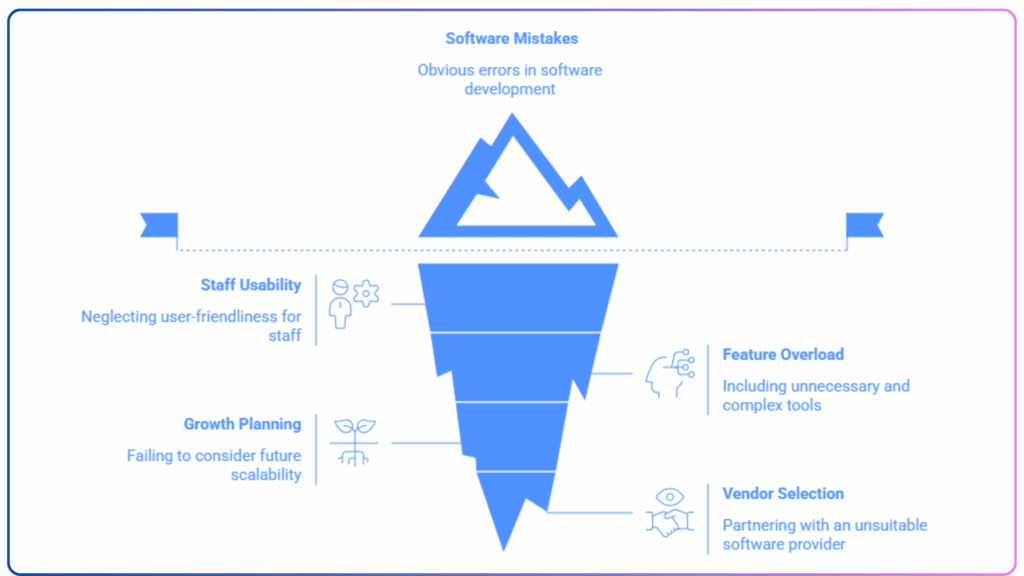
Building restaurant software is a strategic move. When done right, it simplifies operations and supports growth. When done wrong, it becomes another system teams struggle to work around. These are common mistakes we’ve seen businesses make and why avoiding them matters.
Ignoring Staff Usability
One of the biggest mistakes is designing software without involving the people who use it daily.
When usability is ignored:
- Screens become cluttered and slow
- Staff struggle during peak hours
- Training time increases unnecessarily
Well-designed restaurant management system UI design focuses on speed, clarity, and real working conditions. If the staff can’t use the system easily, the software fails no matter how advanced it is.
Overloading Features
More features don’t always mean more value.
Common issues with feature-heavy systems include:
- Low adoption of unused tools
- Increased complexity in daily operations
- Higher maintenance and training costs
Effective restaurant management system features are built around actual needs, not assumptions. The goal is efficiency, not excess.
Not Planning for Future Growth
Some businesses build software only for current needs.
This often leads to:
- Costly rebuilds as the business expands
- Limitations when adding new locations or services
- Difficulty scaling order volumes and reporting
Strong restaurant management software development considers where the business is headed, not just where it stands today.
Choosing Vendors Without Restaurant Experience
Not every software vendor understands restaurant operations.
Without domain experience:
- Workflows don’t match real service patterns
- Integrations feel forced or incomplete
- Delivery timelines slip due to rework
Choosing a partner with restaurant-specific experience ensures the system reflects how restaurants actually operate, front to back, floor to kitchen.
Avoiding these mistakes helps businesses build software that lasts. More importantly, it ensures the system supports people, processes, and growth without becoming a burden over time.
Why Choose CodingWorkX for Restaurant Management Software Development
Choosing a development partner is less about technology and more about trust. The right partner understands restaurant operations, business pressures, and long-term goals without pushing unnecessary complexity. Below is what makes us the right partner:
A Business-First Approach
Being a trustworthy mobile app development company, CodingWorkX approaches restaurant software from an operational perspective, not just a technical one. Every decision starts with how the business runs today and where it needs to go next. The focus stays on solving real problems—order flow, visibility, control, and scalability rather than building features for the sake of it.
Experience Building Scalable Systems
Restaurant businesses don’t stand still. New locations, higher order volumes, and evolving service models are part of growth.
CodingWorkX has experience building systems that:
- Scale smoothly across multiple locations
- Support both dine-in and online-first models
- Adapt as workflows and business structures change
This ensures the software grows with the business, not against it.
Focus on Performance, Usability, and ROI
Good software should feel fast, simple, and reliable—especially during peak hours.
CodingWorkX prioritizes:
- High-performance systems that hold up under pressure
- Clean, intuitive interfaces for staff and managers
- Clear returns through reduced manual work and better decision-making
The goal is measurable value, not technical complexity.
A Long-Term Partnership Mindset
Restaurant software isn’t a one-time project. It evolves as the business evolves.
CodingWorkX works as a long-term partner, supporting improvements, refinements, and future enhancements through its restaurant software development services.
In The End
Every restaurant runs differently, and your software should reflect that reality. The right restaurant management software adapts to your workflows, your team, and your growth plans rather than forcing the business to fit into rigid systems.
For decision-makers, the real value lies in thinking long term. Software built around today’s needs and tomorrow’s direction creates stability, efficiency, and room to scale.
If you’re exploring a system that fits how your restaurant actually operates, a conversation with CodingWorkX can help you assess the right path forward without pressure, and without guesswork.
FAQs
What is a restaurant management system app?
It is a comprehensive tech solution that makes restaurant management’s daily operations smooth. It integrates crucial features like inventory tracking, staff management, customer management, financial reportings, at one place. These software help businesses automate repetitive tasks, enhance productivity and make data-driven decisions.
How can we measure ROI from a restaurant management system?
ROI can be measured through reduced food waste, better labor cost control, faster order processing, and improved reporting accuracy. Over time, restaurants also see gains from higher staff efficiency and increased repeat business. Fewer errors and manual work directly impact profitability.
What are the key features to include in a restaurant management software?
Essential features include POS integrations, real-time inventory tracking, staff management, third-party integrations, financial reporting for full operational control.
How much time does it take to build a robust restaurant management app?
The timeline can vary depending on your specific needs. However, a basic app will take somewhere between 3-4 months and a more complicated system will need 6 to 9 months to complete. For more details, you can connect with our experts.
What tech stack should be used for restaurant management software?
Advanced restaurant management systems often use cloud native tech stack like React for front-end, Python for backend, and MongoDB for database. Also, businesses can use Flutter or React Native for cross-platform compatibility. For cloud use AWS or Azure.
How should I choose the right restaurant management software development company?
It is crucial to pick a company with a proven track record, domain expertise and a business-first approach. Look for teams that focus on usability, performance, and long-term support. A reliable partner understands restaurant workflows and builds software that grows with your business.