
The food delivery app market is surging toward a projected valuation of over $600 billion. This ultimately reflects the necessity of a proprietary digital platform for any business seeking a competitive advantage.
As a result, more and more businesses are now turning to food delivery app development services to grab this growing market opportunity. However, transforming a vision like Zomato or Uber Eats into a scalable reality includes many challenges and presents multiple questions. One such question is “how much does it cost to build a food delivery app?”
The answer to this question differs and can range somewhere between $15,000-$150,000 or beyond. It is due to the fact that food delivery app development cost is variable and depends on multiple factors. And to get a clear idea of your development budget, it’s necessary to deeply understand these components, development workflow and additional factors that may have an impact.
So, this comprehensive food delivery app development guide offers clarity. Here, we will break down every factor influencing the investment, essential features, steps and much more.
Food Delivery App Development Market Overview
First, take a look at these market stats:
- As per recent reports from Grand View Research, the online food delivery market size is going to hit USD 618.36 billion by the end of 2030.
- About 70% of customers like to order online and get food delivered.
By looking at these statistics, it’s not wrong to say that investing in on-demand food delivery app development is a strategic mandate for businesses to secure future revenue growth and market relevance.
Why Is a Food Delivery App Vital for Your Business in 2026?
Businesses are more interested in investing in on-demand food delivery app development to meet pervasive consumer demands for comfort and convenience. This demand is driven by technological enhancements that offer local restaurants improved visibility and market reach.
Moreover, an intuitive food delivery app provides a direct channel for business owners to control the customer experience and the entire sales process. So, if you are also thinking of this venture and wondering how much it costs to build a food delivery app, first, check out the factors that are driving growth in the food delivery app market.
Changing Customer Demands
- Users now prefer quick online ordering
- Rise of on-demand food delivery app development
- 10-30 minute delivery models are the new norm
Market Expansion
- Local restaurants and cloud kitchens are reaching a new audience.
Competitive Pricing
- Users continuously search for the cheapest delivery app
- Business owners focus on balancing services and affordability
And for businesses, this ultimately means investing in scalable food delivery app development is no longer optional. Rather, it is a market mandate for competitive survival in 2026.
Essential Features of a Food Delivery App
To build a successful food app like Zomato, businesses need to think of user expectations, usability, and security. So, below is a detailed breakdown of key features a food delivery platform must have.
User Panel
User interface is essential as it is the part where the user interacts with your food delivery platform. Hence, they should be able to understand it easily and effortlessly.
- User Registration
Allow users to sign up using email, phone number, or social media accounts. Swift onboarding process keeps users interested and engaged.
- Restaurant Listings and Menu
Your food delivery app should include advanced filtering (cuisine, dietary needs, ratings, delivery time), personalized recommendations based on order history.
- Ordering
Quick and easy food ordering process with detailed menus, customization options like add or remove something, and schedule orders for future times. Also, the cart and checkout process should be smooth.
- Order Tracking
Users should be able to view the order status (e.g., Accepted, Preparing, Out for Delivery) and track the delivery partner’s real-time location on an integrated map via GPS.
- Payment Options
Your food delivery platform should offer safe and multiple ways to pay, like credit card, debit card, PayPal, and other mobile payment options.
- Reviews and Ratings
A transparent two-way feedback system allowing users to rate the Restaurant and the Delivery Partner. This way, businesses can ensure service quality and build community trust.
- Push Notifications
It is vital for real-time order updates, preventing uncertainty, and serving personalized marketing promotions and re-engagement campaigns.
Delivery Partner
Drivers should be able to find their way easily and finish deliveries without any hassle.
- Driver Registration
Like users have the option to sign up, same way, drivers can register using their mobile number, email, or social media accounts.
- Real-Time Tracking
Geo-location technology helps drivers with efficient, turn-by-turn navigation from the restaurant to the customer. This is a core feature for reducing fuel costs and guaranteeing faster delivery times.
- Order Management
Clear dashboard that shows receiving, accepting/rejecting, and updating order status. This feature must include all critical details (customer contact, restaurant location, order contents, payout structure).
- Earning Dashboards
Transparent and clear breakdown of earnings, including basic pay, incentives, tips, and delivery history.
Restaurant Owners
Your food delivery platform should make the restaurant’s operations smooth. It must have features that let restaurants manage orders, so they can focus on their core function,, i.e prepare food.
- Menu Management
Restaurant owners should be able to update their menus with new dishes, prices, and descriptions.
- Order Notification
Immediate notifications so that restaurant owners can start preparation right away.
- Payments
Easy and seamless payment integrations to manage restaurant payouts.
Admin Panel
The admin panel is where business owners can manage everything. It is an operational control center that transforms raw data into actionable insights.
- User Management
Admin can manage user accounts, solve issues, and track user activities.
- Restaurant Management
Tools for onboarding new vendors, managing their menus, adjusting commission rates, setting operating hours, and managing promotional listings.
- Analytics and Dashboard
Real-time analytics and reports that key performance indicators and how your food delivery app is doing, how users are interacting with it, and how much revenue it is making.
- Commission and Payment Management
Admin should be able to let restaurants easily change commission charges, and ensure both sides get the fair benefits.
- Discount and Promotion
Tools to create, manage, and track the performance of promotional campaigns, discount codes, and loyalty programs across the entire platform.
Technology Stack Required To Build An App Like Uber Eats
Picking the right technologies and tools is crucial while developing a food delivery platform. Ultimately, the choice made here dictates the performance under high traffic, the speed of feature deployment, and the long-term cost of maintenance. So, take a look at these:
| Component | Technology | Benefit |
| Front-End | Flutter, React, | uses a single codebase for both iOS and Android, drastically reducing development time and food delivery app development cost. |
| Back-End | Node.js, Python | Node is ideal for real-time applications due to its non-blocking, event-driven design and efficiency. |
| Database | MongoDB MySQL | Versatile and flexible for handling a wide variety of data types, working well with real-time data. The traditional database option is ideal for apps requiring well-organized, structured data. |
| Third-Party APIs | Payment Gateways Google Maps AWS | Food delivery app’s functionalities can be improved by integrating third-party services; however, these can increase the final food delivery app design cost. |
Step-By-Step Guide To Food Delivery App Development Guide
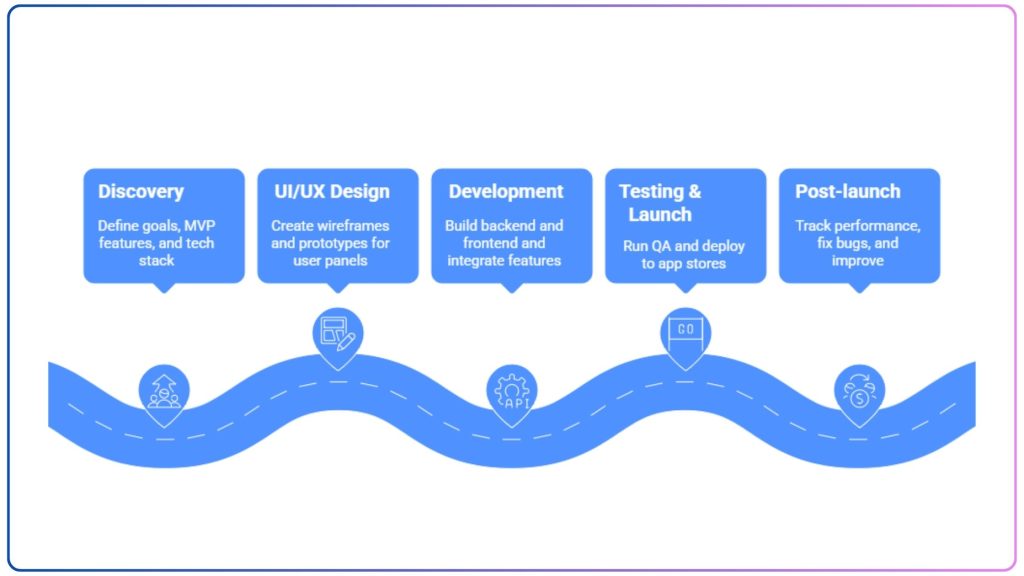
Successful on-demand food delivery app development is not a rush to market. But it is a meticulously planned journey that reduces risk and ensures every investment dollar drives ROI. This strategic food delivery app development guide outlines the five critical steps required to architect a platform engineered for scale, regardless of your projected cost to build an app like Uber Eats.
Phase 1: Strategic Discovery & Definition
This is the foundational stage where we define the Why and the What. We conduct competitive analysis, define your business model, scope the Minimum Viable Product (MVP) feature list, choose the ideal tech stack, and finalize the precise food delivery app development cost breakdown.
Phase 2: UI/UX Design & Prototyping
Our experts create wireframes and high-fidelity prototypes, mapping the seamless user journey for all three panels (Customer, Restaurant, Driver). A sophisticated UI/UX design is a direct investment in user conversion and retention.
Phase 3: Development & Architecture
This is the core coding phase. Here, developers utilize agile methodologies to build the robust backend and native/cross-platform frontends. Critical elements, like Third-Party Integration for payments and maps, are implemented and tested within this structured food delivery app development process.
Phase 4: Quality Assurance (QA) & Deployment
Before launch, the app undergoes rigorous testing, including functional, performance, and security testing. Only after ensuring faultless operation across all user flows is the application prepared and submitted for deployment on the Apple App Store and Google Play Store.
Phase 5: Post-Launch Strategy & Iteration
Deployment is the beginning, not the end. This phase involves continuous monitoring, data analysis, bug fixes, and planning, based on real-world user feedback and market performance.
Factors That Influence Food Delivery App Development Cost
Every business decision, from design choices to the number of features, has a direct influence on your on-demand food delivery app development cost. And knowing these beforehand helps avoid unnecessary budget surprises. This way, you can prioritise what matters most for the success of your app, like Uber Eats.
- Platform Selection
The first and most vital decision is to determine whether to launch on iOS, Android, or both. This is one of the most significant initial cost drivers.
| Method | Costs |
| Native | Native apps offer high performance and the best user experience. But this approach may double the initial cost to build an app like Zomato and can range somewhere $12,000 – $50,000. |
| Cross-Platform | Utilizing frameworks like Flutter, React Native enables developers to use a single codebase to build apps that run on both platforms. This ultimately reduces the food delivery app design cost, ranging between $10,000 – $50,000. |
- App Complexity
Complexity is measured by the number of user roles and the depth of features. A multi-sided platform like Zomato or Uber Eats is inherently expensive because it requires three distinct applications:
- Customer App: For browsing and ordering.
- Restaurant/Vendor App: For accepting, managing, and fulfilling orders.
- Driver/Courier App: For real-time location, route management, and delivery confirmation.
Each additional screen, feature, or integration directly increases the total food delivery app development cost.
And if we talk about numbers, a basic app with simple features will cost you around $5,000 to $22,000. On the other hand, an advanced app with complex features will cost somewhere between $8,000-$45,000.
- UI/UX Design
Your app’s UI and UX are the foundation of user retention. While templated design is cheaper to use, it compromises your brand’s identity. Good designs, on the other hand, would increase the final budget, as they require more development time and effort. But remember, in the end, a well-designed food delivery app will result in satisfied customers, hence higher return on investment.
Below is a detailed breakdown of the cost to build an app like Zomato based on UI/UX.
| Type | Cost Involved |
| Custom | $6,000 – $10,000 |
| Template-Based | $10,000 – $30,000 |
- Third-Party Integration
As a business owner, you want your app to work smoothly; hence, there is a need to integrate third-party services. And every external service you integrate, beyond the basic ones, adds cost. These third-party APIs or services come with a price. This ultimately enhances the cost to build an app like Uber Eats. Also, the final cost is influenced by how difficult it is to integrate these services.
| API Type | Cost Involved | Time Estimations |
| Payment API | $2,000 – $5,000 | 1 to 2 weeks |
| Location Tracking | $4,000 – $7,000 | 2 to 3 weeks |
| Messaging | $2,000 – $4,500 | 1 to 2 weeks |
- Technology Stack Selection
The programming languages, frameworks, libraries, and databases chosen determine the development efficiency and future maintenance cost.
| Technology Chosen | Cost Involved |
| Frontend (React Native/Flutter) | $8,000 – $25,000 |
| Backend (Node.js/Python) | $10,000 – $30,000 |
| Cloud Solutions (AWS/ Azure) | $2,000 – $10,000 |
| Total Tech Stack Costs | $20,000 – $65,000 |
- Team Size and Expertise
It is one of the major factors influencing the cost to build an app like Zomato. Your development team often includes a project manager, UI/UX designer, 2-4 developers, and QA engineers. Hiring a highly proficient team would increase the overall food delivery app development cost.
- Development Team’s Location
The geographic location of your food delivery app development company dictates hourly rates. Also, adapting apps for different time zones, currencies, and languages requires effort. This ultimately adds a level of complexity to the development process, increasing the cost to develop a food delivery app. Furthermore, different countries have different development rates.
Additional Cost to Develop a Food Delivery App
While estimating the cost to build an app like Uber Eats, it is crucial to consider additional expenses.
1. Marketing and Promotion
Once your food app is ready, it’s time to attract users, but it takes money. You need to promote your food delivery platform on social media, invest in online advertising, and collaborate with influencers. Typically, it will cost you around $10,000 to $55,000, depending on your campaign size.
| Marketing Expense | Estimated Cost |
| Social Media & Ads | $10 1000 -$35,000 |
| Influencer Partnerships | $5,000 – $25,0000 |
2. Third-Party Services
A scalable food delivery platform relies heavily on integrating best-in-class third-party services, often through subscription or pay-per-use APIs. These costs are vital for operational excellence and ongoing function. Depending on your app size, these services can cost anywhere from $500 to $6,000.
| Third-Party Service | Estimated Cost |
| Google Maps API | $200 to $1100 |
| Payment Gateway | $500 to $3300 |
| Cloud Service | $300 to $ 5000 |
3. App Store/Play Store Publishing Costs
To distribute your food delivery application to the global market, you must register as a developer with the respective platforms. These are minor, yet mandatory, fixed costs:
| Platform | Estimated Cost |
| Google Play (one-time) | $25 |
| Apple App Store (annual) | $99 |
4. Legal and Compliance Costs
Ignoring the legal framework surrounding your business model is one of the critical mistakes that may result in major financial risks. Depending on the complexity and location of your food delivery app, there can be legal fees ranging from $5,000 to $22,000.
| Legal and Compliance | Estimated Cost |
| Data Privacy Compliance | $6,000 – $10,000 |
| Legal Documentation | $4,000 – $10,000 |
Expert Tips To Reduce Food Delivery App Development Cost
Building a robust food delivery app is quite expensive. But strategic steps can help optimize the cost to build an app like Zomato without compromising the quality. Ultimately, when you plan carefully and leverage top-notch technology, you can have a fully functional and scalable food delivery app within your budget. So, take a look at the strategies below to maximize your investment.
- Start With an MVP
For the initial version of your food delivery app, consider only must-have features. By focusing on this initial scope, businesses can accelerate their time-to-market, start generating revenue sooner, and use real-world user data to guide subsequent feature development. This ultimately reduces the risk and cost associated with building features users don’t need.
Also, it is wise to consult with an MVP development company to craft engaging and budget-friendly food delivery MVPs.
- Utilize Existing Tools and Solutions
It is better to integrate third-party tools and APIs like payment gateways, mapping, and notifications, rather than building custom ones. Using pre-built components and tools helps accelerate the development process, along with reducing the overall budget. Furthermore, pre-built libraries offer tested functionalities for free.
- Outsource ToCost-Effectivee Regions
Outsourcing brings multiple benefits, like hiring expert developers without paying for infrastructure, recruitment, and long-term commitments. But before making a final decision, it is vital to review the portfolios carefully and check references first.
Furthermore, hiring developers from countries with lower labor costs, including South Asia, Eastern Europe, or Southeast Asia, can minimize your overall food delivery app development cost. These teams provide high-quality services at a fraction of the cost of North American or Western European teams.
- Cloud-Based Structures
Cloud services like AWS or Google Cloud reduce the upfront cost of servers. Unlike traditional fixed-server infrastructure, cloud services allow your platform to scale its resources (and costs) dynamically based on actual usage. You only pay for the capacity you use during traffic peaks, which ultimately leads to substantial savings during off-peak hours.
- Cross-Platform Development
Developing native apps for both iOS and Android simultaneously is expensive. On the other hand, for an MVP or initial launch, cross-platform development using frameworks like React Native or Flutter is an effective investment multiplier.
This approach allows a single codebase to run across both mobile operating systems, dramatically reducing development time, resources, and maintenance costs without sacrificing the essential native user experience and performance required for a successful on-demand food delivery app development.
- Only Include Essential Features
During the initial phase, prioritise features based on business impact and user necessity, not on “nice-to-have” lists. By deferring high-cost features like in-app social, multi-level subscriptions, etc., businesses can ensure that the initial capital is spent on the core architecture. This way, they can launch apps faster, start earning, and validate their market fit before any further significant investment is made.
Monetization Strategies for On-Demand Food Delivery App Development
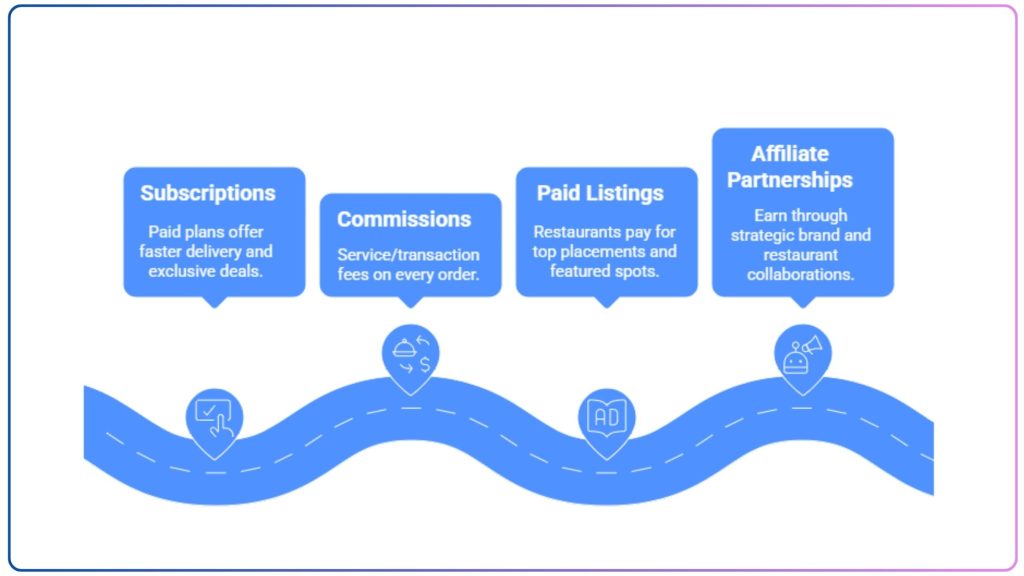
The success of your app, like Zomato or Uber Eats, hinges on a multi-layered revenue strategy. Ultimately, having a strategic revenue model ensures that your food delivery app returns meaningful value to your business. Here are the critical monetization models:
Subscription-Based
Include subscription plans for customers with benefits like fast delivery, exclusive discounts, and early access to deals. This model transforms casual users into loyal subscribers, guaranteeing recurring revenue.
Transaction Fees and Commissions
This approach is crucial for balancing the cost to develop a food delivery app against immediate returns. Businesses can charge a commission or service charge on every order made on the app.
Cross-Selling Restaurants and Delivery Services
Once your platform establishes significant user traffic, you can leverage that audience to generate high-margin revenue by selling visibility and premium placement to vendors. Also, you can charge restaurants a premium fee for appearing on top, on the homepage, or in any specific category listing.
Affiliate Partnerships
Having strategic partnerships with local restaurants or non-competitive businesses allows your platform to create a diversified, passive income stream that enhances the overall user ecosystem.
Why Choose CodingWorkX as your Food Delivery App Development Company?
A food delivery app is not just a digital menu. Rather, it is a complex, high-traffic ecosystem. As a future-forward mobile app development company, we at CodingWorkX approach food delivery apps as a strategic business asset. We focus on delivering an intelligent and user-centric platform that ensures your operational efficiency and drives exponential revenue growth.
Our experts simplify your food delivery app development process and address challenges effectively. Regardless of whether you are going to launch a local delivery app or expand internationally, we create scalable and tailored solutions. Also, we can guide you in estimating the cost to build an app like Uber Eats, along with choosing the right features, tech stack, and approach.
Partner with CodingWorkX to transform your vision into a scalable, market-ready food delivery platform.
In the End
By now, you must have successfully navigated our complete food delivery app development guide and now possess the strategic blueprint for your platform. Remember that the food delivery app development cost is not a generic price tag. Rather, it is a strategic investment and can range somewhere between $15,000-$100,000+.
In addition, you can minimize the risk and maximize your ROI by partnering with a leading food delivery app development company that can translate this strategy into a high-performing, cost-effective reality.
FAQs
How long does it take for food delivery app development?
Building a food delivery app like Uber Eats often requires 4 to 8 months. However, the exact time depends on your app’s complexity and the features you include. A reliable food delivery app development company can guide you through the process of estimating the final cost.
What are the cost-driving factors of food delivery app development cost?
The key factors that can drive the final budget are the complexity of the project, the number of features and functionalities, advanced features like live tracking, multiple payment methods, development team size and location, and many more.
What features should a food delivery app include?
An intuitive food delivery app must have these features:
- User side- signup, search, real-time order tracking, multiple payment options.
- Restaurant side- offers, order dashboard
- Delivery partners- order control, earnings view, route optimization
- Admin panel- user and restaurant management, analytics
Do UI/UX choices influence the food delivery app development cost?
Yes. Tailored UI/UX decision, especially if they have advanced features like personalization, virtual assistance, etc. Often requires more development hours and time, which ultimately results in a higher development budget.
How much does it cost to build a food delivery app?
The cost to build an app like Uber Eats is a strategic investment variable, defined entirely by platform complexity, features, and required operational scale.
While a feature-rich MVP designed for validation typically starts in the $40,000 – $70,000 range, a fully architected, multi-sided marketplace requires capital exceeding $150,000 to ensure future-proof growth and scalability.