
We are living in a technology-first era, where everything is interconnected. It raises the most important question: what do businesses need to stay ahead? Is it the profit or customer satisfaction? Also, as the market is full of new trends, like AI, cybersecurity, cloud computing, AR/VR, and others, it’s not easy to meet customers’ needs.
Well, similar kinds of enterprise challenges are faced by big brands like FedEx, trying to track its packages instantly; automotive giant Toyota, looking to expand its reach; and even big coffee chains like Starbucks, having problems with their operations. This makes it vital for businesses to have the right solutions to go with the emerging trends and enhance operational efficiency.
Furthermore, as per recent reports, the global enterprise app market is expected to hit USD 625.66 billion by 2030, and it is growing astonishingly at a CAGR of 11.8% from 2025 to 2030. So, every tap, notification, and swipe determines whether a business will be successful or fail in this market. Also, about 6.3 billion users download apps every day worldwide. This data speaks a lot. And if your business is lagging behind this technological revolution, you will miss your share of the pie.
To help you overcome operational challenges, our enterprise app development guide will walk you through everything—what it is, its advantages, core features, how to build an enterprise application, and much more. On that note, let’s dive in.
What is Enterprise Application Development?
Enterprise mobile app development is about creating robust software that satisfies intricate business needs. These tools assist businesses in managing data, streamlining processes, and smoothly integrating with various systems.
The users of enterprise apps are often an organization’s employees. They are not like regular apps; rather, they focus on business processes. Hence, enterprise app development is more complicated than creating a basic online store. A few examples of such apps are Salesforce CRM, HubSpot CRM, and others.
Benefits of Enterprise App Development for Your Business
It is better to have an idea of how building enterprise mobility solutions can be beneficial for you. So, let’s take a closer look at the advantages mentioned below:
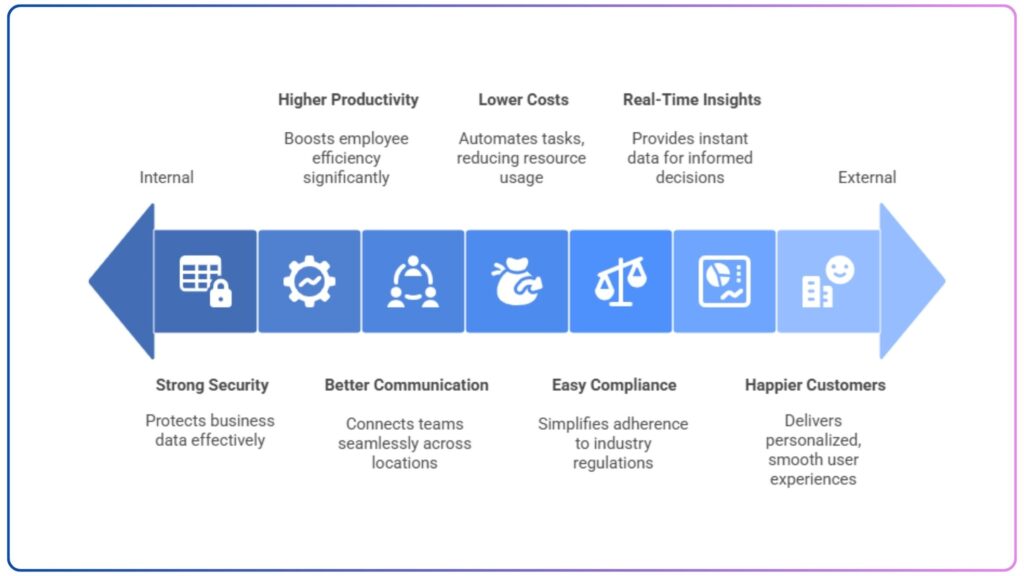
- Enhanced Data Security
Enterprise mobile solutions build robust security through different protective layers, such as safe connection methods, multi-factor authentication, etc. All these safety features keep confidential data, customer records, and business methods protected from theft and unauthorized access.
- Improved Productivity
When you provide your employees with enterprise mobile solutions, they can access the features directly from anywhere, and, as a result, they finish tasks more effectively. In addition, this decreases waiting times, removes repetitive manual work, and keeps employees focused on valuable activities that push the company ahead.
- Better Communication
Enterprise applications offer a smooth conversation path for both the organization’s team and outside partners via quick messaging, video conferencing, and shared work displays. This way, teams stay connected regardless of their department or location. With better coordination, businesses experience stronger teamwork and more engaged employees who feel connected to business goals.
- Cost-Effective
By using available resources effectively and automating manual tasks, enterprise app development helps generate more revenue. Also, enterprise solutions offer an in-depth understanding of industry processes and functions. So, businesses can accordingly change their processes, make predictions, and enhance profitability.
- Compliance with Industry Standards
Many enterprise solutions come with built-in reporting and tracking features, which help organizations stick to industry compliance along with protecting customer data. Also, keeping electronic records, storing documents safely, and monitoring automatically reduces the risk of error and protects the company from legal issues.
This is necessary for a few industries like healthcare, banking, etc., where one mistake can cost millions.
- Real-Time Data Insights
A robust and intuitive enterprise mobile app lets you check control panels, data breakdown, and performance without any hassle. So, business leaders and managers keep a watch on necessary numbers and make informed decisions using correct facts, and plan for the future using updated information.
- Happy Customers
When businesses invest in enterprise mobile app development, they can offer tailored experiences. Also, customers can access their account information and explore support and other vital features directly. They can get instant updates, handle purchases efficiently, and resolve their issues effortlessly.
Ultimately, enterprise solutions enhance customer loyalty, improve satisfaction scores, and make customers more satisfied as they feel more empowered.
Essential Features for Enterprise App Development
It is necessary to have the right strategy, development team, and a deep understanding of core features in place to create successful enterprise software. So, below is a brief of these:
- User Authentication
Typically, it consists of single sign-on integrations, multi-factor authentication (OTPs), biometric authentication (facial recognition and fingerprint), and login credentials (password and username combinations). User authentication aids in preventing fraud, illegal access, and data breaches.
- Role-Based Access
While enterprise apps give employees quick access to data, not everyone in the organization should see everything. That’s why businesses need a feature that lets them assign different user roles to employee accounts. For example, if a vendor logs into your app, they should only see order-related information. With user roles, they won’t be able to view sensitive internal data like performance reports or financial details.
- Automation
Automation of repetitive, manual tasks is a core requirement for most enterprise apps.
Therefore, you should have a solution capable of handling repetitive tasks and improving productivity by integrating advanced technologies like ML and AI.
- Real-time Analytics and Reporting
A single choice can determine a company’s success or failure in a fast-paced market. Hence, to have real-time analysis for well-informed decision-making, analytics must be integrated into your enterprise software.
- Collaboration and Data Sharing Tools
Enterprise software should have the feature for messaging, project collaboration, and document sharing to facilitate teamwork, communication, and knowledge sharing. This way, organizations can communicate effortlessly between teams, stakeholders, or clients in the chosen format.
- Offline Access
With offline data synchronization, you enable users to access and engage with the tool while they are offline or have internet issues. This way, teams can work effortlessly without facing any problems like buffering, regardless of location.
- Cloud Storage
The main goal of custom enterprise application development is to supply organizations with a method to access data anywhere and anytime. Therefore, apps need to store data in the cloud so users and organizations can easily access important information whenever they need it.
Types of Enterprise App Development
Enterprise-grade mobile apps are often created to handle different organizational requirements. Each type of enterprise app presents businesses with capabilities to streamline their daily operations and enhance their efficiency.
- Customer Relationship Management (CRM)
A robust CRM app encourages businesses to handle customer relationships, track sales movement, and improve customer fulfillment. These apps often include features like customer support, connection management, lead tracking, and sales analytics.
- Supply Chain Management (SCM)
These apps concentrate on improving the flow of goods, services, and data across the supply chain. SCM solutions often automate logistics and inventory for accurate demand forecasting and minimizing disruptions. By integrating real-time tracking, businesses can avoid stockouts, reduce expenses, and improve supplier relationships.
- Enterprise Resource Planning
ERP applications include multiple business functions and departments like human resources, finance, and others. Ultimately, enterprise software development helps organizations to supervise and automate enterprise processes and improve efficiency and information accuracy.
- Business Intelligence (BI)
Your organization deals with massive amounts of data from sales. Hence, business intelligence tools help compile, examine, and extract valuable data to make informed decisions. Microsoft Power BI and Tableau are two popular BI tools that use machine learning and advanced analytics to discover patterns and predict trends. These apps often include features like visual dashboards, reporting, data integration, and predictive analytics.
- Human Resource Management (HRM)
Regardless of size, it is quite difficult to hire and manage personnel efficiently for organizations. HRM applications like Oracle and Workday help manage recruitment, payroll, benefits administration, and workforce planning. Additionally, with the assistance of a reliable enterprise app development company, you can automate HR procedures, improve employee engagement, and guarantee adherence to labor laws and limitations.
- Content Management Systems (CMS)
CMS software assists enterprises in creating and publishing digital content, including website content, blogs, articles, press releases, etc. These applications offer tools for editing, version control, content creation, and publishing while ensuring consistent content delivery.
- Collaboration and Communication Tools
When it comes to communication, enterprise app development helps keep teams connected regardless of working time zones. These tools make workplace conversations smooth and enhance productivity, along with information sharing for business expansion.
Enterprise App Development: Step-By-Step Guide
Businesses need powerful enterprise software to gain a competitive advantage and modernize their internal operations. However, enterprise app development requires strategic planning, an expert team and an understanding of steps involved. So, let’s jump in to see what these steps are:
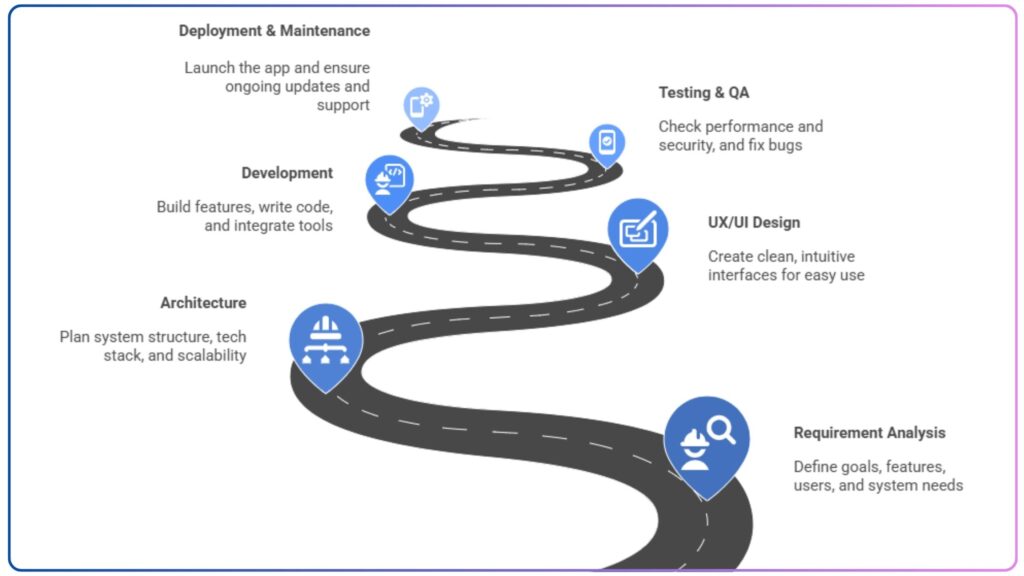
Requirement Analysis
It is the foundational stage where the necessities and goals of organizations are comprehended. This includes a detailed discussion with stakeholders, evaluating existing processes, and documenting the business needs, key functionalities, user roles, security protocols, and integration points with existing systems. This phase sets a basis for further stages in enterprise mobile app development.
Architecture
Once requirements are clear, the development team designs the architecture of the enterprise app. A reliable enterprise software development company can help businesses characterize the structure of the system, database design, and plans for security and scalability.
UX/UI Design
Enterprise apps need to be more functional. Rather than being intuitive. Here, UI/UX designers focus on creating an exceptional User Experience (UX) and a clean, professional User Interface (UI). And when you work with a professional team, they bring industry knowledge of interface necessities, information accessibility, and navigation flow.
Development
With the design and architecture approved, here developers bring the application to life. The developers write code, integrate third-party services, and assemble the enterprise app.
Testing and QA
A strict quality assurance process for the enterprise mobile app development platform ensures that your app is free of bugs and functions smoothly. Ultimately, it is vital to involve end users in the testing processes to yield the maximum value.
Deployment and Maintenance
The final application is strategically deployed to your chosen environment (Cloud or On-Premise). But our partnership doesn’t end there. We provide ongoing support and maintenance to monitor performance, apply necessary updates, and manage future enhancements. This continuous effort ensures your enterprise app remains a stable and valuable asset for years to come.
Factors To Consider While Building an Enterprise App
So you have decided to create robust enterprise software. However, before starting the custom enterprise application development, you need to consider a few elements. When you have a skilled team, they will take care of everything, but you should be aware of these key aspects.
Choice of Platform
The platform (iOS or Android) you pick often has a huge impact on the features, functionalities, and enterprise app development cost.
Target Audience
It is of top priority to understand who is going to use the app before starting the enterprise app development process. You should have a few details like consumers using the app, age group, whether users will be using it on desktop or mobile, etc.; otherwise, your resulting app will lack the crucial features and can lead to major financial loss.
Mobile Analytics
Integrating strong analytics into your enterprise app development is vital from day one. These tools help track user behavior, identify performance bottlenecks, and monitor usage patterns. This way, businesses can analyze the data and use it wisely to enhance the app’s performance.
UI/UX Design
If you want your employees to adopt a new system quickly, your app should offer an exceptional user experience. A complicated interface often leads to lower adoption rates and increased training costs. Hence, work with a trusted UI/UX design agency to ensure your app’s UI is clean, intuitive, efficient, and enables users to complete their tasks with minimal friction.
Security
For companies stepping into enterprise software development, having vigorous security measures is necessary to protect confidential data. And as user data is becoming more precious, you should have a capable and dependable system to store it.
Third-Party Integrations
To enhance the usefulness of enterprise software development, it is necessary to integrate third-party services like PayPal for payment.
Ultimately, understanding these factors is vital for businesses looking to grow over time.
Understanding Enterprise Mobile App Development Cost
It is not possible to give you an exact price, but enterprise software development costs can range somewhere between $50,000 and $500,000. Also, your investment can be influenced by multiple factors:
- Number of features and functionalities
- Level of customization required
- Number of users and workflow
- Security level
- Testing and QA
- Amount of data storage and analytics
- Scalability
Below is a brief breakdown of the cost based on complexity level:
| App’s Complexity | Features | Cost Involved |
| Simple app | LoginUser ProfileDashboard | $20,000 – $85,000 |
| Medium | Login User ProfileDashboardSocial Media IntegrationsPayment GatewaysAudio/Video StreamingUser Privacy | $90,000 – $250,000 |
| Highly Complex | Login User ProfileDashboardSocial Media IntegrationsPayment GatewaysAudio/Video StreamingUser PrivacyHigh-end Data Logic Multi-Language Support | $250,000 to $50,000 |
It is clear from the table that advanced features and functionalities require more effort and resources. That’s why systematic planning, strategy, and timely testing are necessary.
Furthermore, businesses need to consider ongoing costs for the following:
- Hosting expenses and infrastructure
- Continuous maintenance
- Ongoing advancements and new features
Challenges in Enterprise App Development
Enterprise apps are becoming popular day by day and changing the way businesses operate. However, building a custom enterprise mobile app brings its own challenges. And some of these are mentioned below:
- Complex integration
- Insufficient resources
- Higher development costs
- Data security issues
- User change adoption
However, a leading mobile app development company can help you implement technological solutions to these issues.
How CodingWorkX Can Help in Custom Enterprise Application Development
With our enterprise app development services, organizations, regardless of size, can push their efficiency and streamline their processes. Being a future-forward custom software development company, we at CodingWorkX leverage cutting-edge technologies, including AI, ML, big data, and Flutter, to deliver high-performing and scalable enterprise apps.
Our experts believe in automating and enhancing the efficiency of operational workflows with our enterprise digital transformation apps. We empower your employees with specialized enterprise solutions to drive measurable results. By incorporating comprehensive market research and real-time data analytics, we turn everyday business processes into strategic advantages.
So, in case you are looking for an ever-evolving enterprise app development company, we are here in the town. Just express your app vision to our experts, and they will guide you on everything, including enterprise app development cost, features, and others.
FAQs
What is enterprise app development?
Enterprise mobile app development is a process of building software applications for large organizations, and its primary audience is the employees of that organization. These apps help streamline daily operations and communication among teams across all levels.
How much does it cost to build enterprise applications?
It is difficult to give a fixed answer for this. It is due to the fact that the cost to build enterprise-grade mobile apps depends on multiple factors, like complexity and the type of app you want. But on average, a basic app will cost you somewhere between $50,000 and $100,000; on the other hand, a complex app with advanced features will range anywhere between $250,000 and $500,000.
What are the best strategies to ensure security in enterprise app development?
You can follow these—use strong security measures like multi-factor authentication, encryption, setting up permission levels, running security checks, and using threat monitoring tools.
What are the advantages of enterprise software development?
There are multiple benefits of enterprise app development, like improved productivity, better customer engagement, data-driven decisions, and automated workflow.