
On average, a pharmacist who manages 300+ prescriptions daily with paper logs, manual insurance verifications, and standalone cash registers faces a different reality than one using integrated pharmacy management software. And the pharmacy management software market is showing this shift clearly. As it is forecasted to grow beyond $55.63 billion by 3032
This is because by using the right software, pharma businesses cut costs, reduce human errors, and improve their inventory, all while nurturing patient relationships. It’s ultimately the way to future-proof your business process while delivering better care.
So, on that note, continue reading this blog, as here we will cover everything about pharmacy management development, its types, key features, pharmacy management software cost, and much more. Also, see how having a reputable custom software development company on your side can guide you through the process.
What is Pharmacy Management Software?
Pharmacy management software is basically the heart of your pharmacy. It helps keep everything like inventory, billing, insurance claims, compliance, and clinical checks in one place. This makes the operations more efficient and reduces paperwork while improving customer service.
Also, pharmacy management software development offers an integrated digital platform that manages:
- Stock control
- ePrescribing & dispensing
- Insurance claims & billing
- Patient profiles
- Reporting & compliance
Market Overview of Pharmacy Software Development
- The pharmacy software market is going to hit 8 billion by the end of 2030.
- Today, about 83% of pharma businesses run their core work process in the cloud, and hence the industry’s cloud investment is going to exceed USD 59.37 billion by 2030.
- AI-powered pharmacy software decreases inventory levels by about 20% via correct demand forecasting and optimized strategies.
Types of Pharmacy Management Software
Every pharmacy has its own different needs. And the choice of software depends on operational needs, patient volume, and other clinical requirements:
- Retail pharmacy software
These systems focus on patient-facing features like counseling documentation tools, loyalty programs, and consumer communication like text reminders.
- Hospital pharmacy systems
Inpatient systems focus on medication administration records (MAR), IV compounding documentation, clinical decision support, and EHR integration. These make coordination between nursing workflows and physician ordering smooth.
- Chain & franchise pharmacy management
Managing multiple locations adds operational complexity. Chain pharmacy management software centralizes inventory, pricing, and reporting. It allows leadership teams to monitor performance across branches from one system.
- Online/ePharmacy platforms
Digital pharmacies operate at scale. These platforms support online prescriptions, digital payments, and home delivery workflows. Pharmacy software development for ePharmacies also focuses on security and compliance.
- Wholesale & distributor-focused systems
Distributors manage large volumes of medicine. Wholesale pharmacy software tracks bulk inventory, pricing changes, and order fulfillment. It also supports vendor coordination and supply chain planning.
Why Businesses Should Invest in Pharmacy Software Development
Pharmacy companies get multiple benefits, such as
Better efficiency and productivity
Daily tasks take less time when systems are connected. Repetitive work is reduced. Teams can focus more on patients and less on paperwork.
Error reduction
Trusted pharmacy software flags unsafe errors like drug interactions and improper dosage. This results in lower risk and better safety.
Improved patient experience
Simplified checkouts, faster service, fewer errors, and engaging patient portals make communication easier. This ultimately lets your patients feel better and cared for and come back for service.
Data-driven decisions
With integrations of analytics, reliable pharmacy inventory management software gathers information to deliver actionable reports that enable business pharmacies to make better decisions for staffing, inventory, and other services.
Better financial outcomes
Pharmacy software development helps in better utilization of resources and increases labor efficiency. This software offers actionable data insights that help pharmacy businesses make wise decisions about pricing and customer preferences.
Integration with Existing Systems
Regardless of whether you are using EHR (electronic health record), POS (point of sale), health insurance platforms, financial tools, or any other, PMS integration can make the overall workflow smooth.
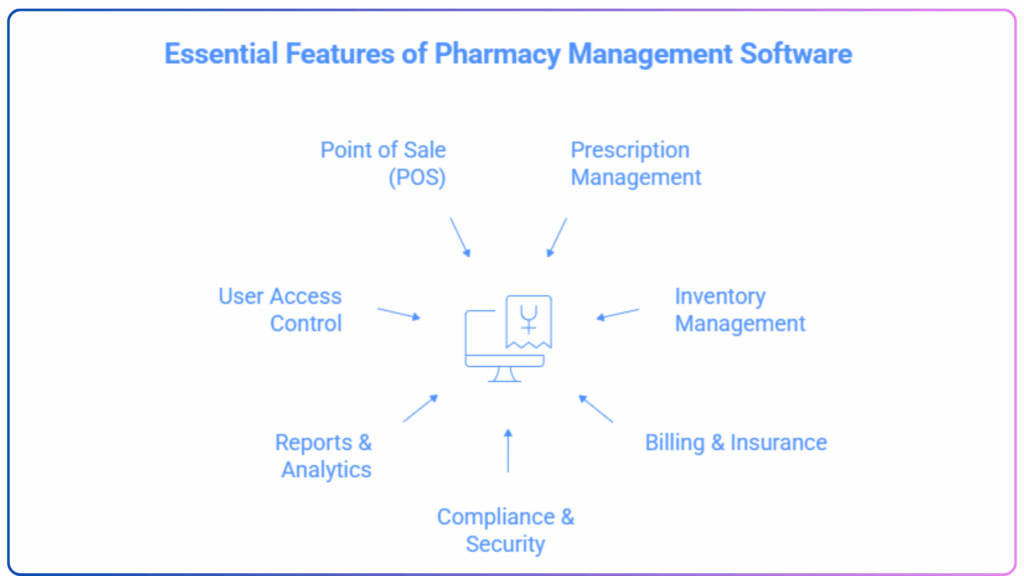
Must-Have Features of Pharmacy Management Software
Below are the features that should be integrated:
Prescription Management
A trusted prescription management software should make it easy for pharmacists to track and manage prescriptions. Also, it should support the digitization of prescriptions, along with offering easy access to patient history.
Real-Time Inventory Management
This feature ensures that there are enough drugs and supplies in the pharmacy. It provides real-time updates on inventory levels and automatically generates reorder points while giving low stock alerts and expiry warnings. This ultimately reduces potential loss, which results from expired products.
Billing & Insurance Claims
Billing errors slow down cash flow. Insurance claims add another layer of complexity. Pharmacy management software automates billing calculations and claim submissions. This improves accuracy and speeds up reimbursements.
Regulatory Compliance & Security Modules
Pharmacies must follow strict healthcare regulations. HIPAA-compliant pharmacy software protects patient data at every stage. Security modules control data access and maintain audit logs. This reduces compliance risks.
Reporting & Analytics
Data is only useful when it is easy to understand. Pharmacy software generates clear reports on sales, inventory, and performance. These insights support better planning and smarter decisions.
User Access Control
Not every staff member needs full system access. Role-based access keeps sensitive information secure. Pharmacy management software allows admins to define permissions for each user.
Point of Sale
The checkout experience matters. An integrated POS system speeds up transactions. It automatically syncs sales data with inventory. This keeps stock records accurate at all times.
Tech Stack Used for Pharmacy Software Development
Your tech stack must be flexible and scalable to ensure your pharmacy inventory management software is reliable and easy to integrate with. Below are a few common tools:
| Layer | Tech Stack |
| Frontend | Angular, Swift |
| Backend | Python, Node.js |
| Database | MySQL, PostgreSQL |
| Payment gateways | Braintree, PayPal, Stripe |
| Hosting platform | AWS, Google Cloud |
| Analytics | Google Analytics |
Pharmacy Management Software Development Process—Step By Step
A clear roadmap saves both money and time, so here is a proven path to build innovative HIPAA-compliant pharmacy software.
Discovery & Requirement
This phase includes stakeholders’ interviews, the mapping process over time, defining the regulatory baseline, etc. Collect business requirements and user expectations so the product integrates effectively from day one.
Workflow Design
Design how the user experience and database will work together, and reduce screen changes. Design patient-facing UX like easy refills, tracking, and payments.
Architecture & Data Model
Data models are planned to handle prescriptions, inventory, billing, and compliance data. This ensures the pharmacy management software remains scalable and secure.
Development & Integrations
Your chosen healthcare app development company will build core features at this phase. Integrations with EHR systems, billing tools, and inventory platforms are added. This allows the pharmacy software to work smoothly with existing systems.
Data Migration & Parallel Runs
Legacy data must move without disruption. Historical records are migrated carefully. Parallel runs help compare old and new systems. This reduces risk before full rollout.
Validation & Testing
Testing ensures reliability. Functional, security, and compliance testing are carried out. HIPAA-compliant pharmacy software must pass strict validation checks before launch.
Ongoing Support & Maintenance
Software needs continuous care. Updates, security patches, and performance improvements are handled post-launch. Ongoing support keeps the pharmacy management software reliable as business needs change.
How Much Does Pharmacy Management Software Development Cost?
It is necessary to understand the pharmacy management software cost, as multiple components contribute to the final budget. On average, it will range somewhere between $40,000 and $300,000.
Below is a brief breakdown of the cost involved based on complexity:
| Software Complexity | Estimated Cost | Core features |
| Basic pharmacy software | $40,000 to $65,000 | Billing, inventory |
| Mid-level pharmacy software | $65,000 to $100,000 | Advanced features, multiple integrations |
| Advanced/Enterprise software | $110,000 to $300,000 | Multi-site operations, full clinical integrations |
Key Elements That Influence Pharmacy Management Software Cost
- Complexity
- Modern technologies & tools
- Third-party integrations
- UI/UX design complexity
- Data migration
- Cloud solutions
- Compliance & security
To get more details on healthcare app development, go through this guide.
Regulatory and Compliance Considerations For Pharmacy Management Software
These apps hold a lot of sensitive health data; hence, it’s vital not to ignore compliance.
HIPAA/GDPR
This safeguards patient data by integrating strict security measures, patient consent, and legal rights of access, correction, and use of sensitive information in a safe environment.
E-prescribing
Confirms that all digital prescriptions follow national rules, such as DEA standards, and validates prescriber identities to ensure that they are not abusing the system or submitting fraudulent prescriptions.
Audit Trails & Logging
Log and audit every user action in relation to data and be 100% accountable for every action in accessing and making changes to data, to better meet any regulatory inspections or investigation requirements.
Data Localization
It requires data to be stored within a physical border to avoid unlawful cross-border data flow and guarantee compliance.
Secure Access
Protect systems with strong access controls, such as two-factor authentication, role-based privileges, and session timeouts, to prevent unauthorized users from accessing sensitive health records.
Regular Audits and Updates
This includes detecting and resolving issues before they lead to a breach or fines by using security patches, vulnerability scans, and routine compliance audits.
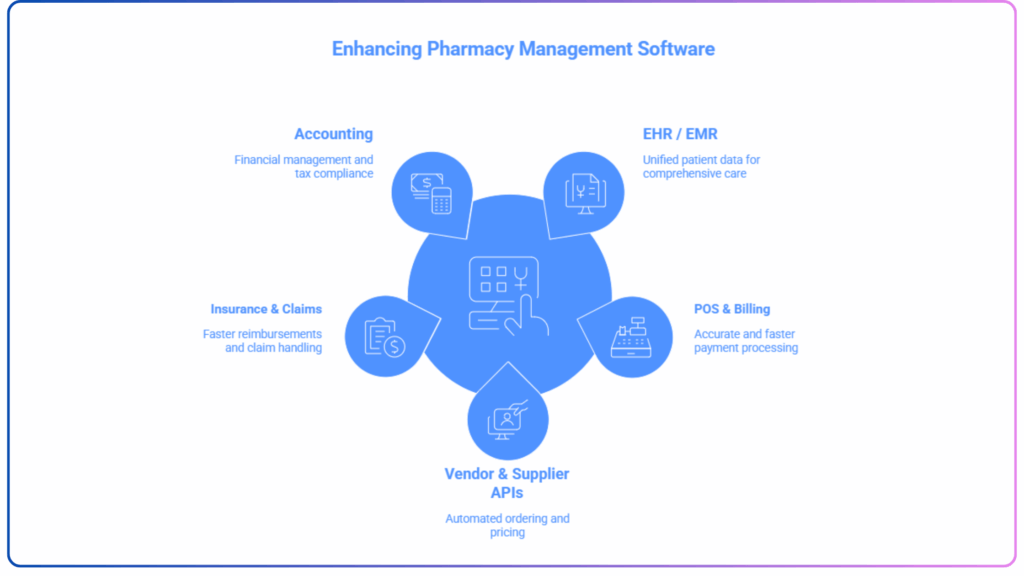
Third-Party Integrations in Pharmacy Management Software
Advanced pharmacy software connects different parts to streamline operations and decrease manual work. The integrations given below make sure data flows smoothly.
EHR/EMR systems
Connecting your HIPAA-compliant pharmacy software to an EHR like Allscripts provides you with a complete patient medical history, improves care coordination, and reduces duplicate data entry.
POS & billing software
Payment integrations handle standard processors and healthcare-specific requirements, splitting billing between insurance and patient responsibility. These integrations decrease errors and make financial workflow simple. This way, you can maintain optimal inventory without tracking it manually.
Vendor & supplier APIs
Integrating with distributors like McKesson helps automate ordering, real-time cost updates, and alerts. Real-time pricing and availability updates help pharmacies plan inventory better.
Insurance & claims processing
Insurance workflows are complex. Integrated claims systems reduce manual form handling. Claims are submitted faster and tracked easily. This improves reimbursement timelines and reduces errors.
Accounting (ERP, GST systems)
Financial data must remain accurate. ERP and GST integrations sync invoices, taxes, and payments automatically. This way, you can reduce reconciliation work and make financial reporting better.
Use Cases of Pharmacy Software with Real-Life Examples
Key use cases of pharmacy software are automated prescription processing, real-time inventory tracking, client engagement, etc.
Also, pharmacy management software streamlines billing and claims while ensuring compliance and accurate documentation. And each use case shows how technology is changing everyday pharmacy operations.
Automated Prescription Processing
Pharmacy inventory management software minimizes manual errors and streamlines workflows by digitizing the prescription process. Real-life example: Amazon Pharmacy uses AI-backed systems to verify and manage prescriptions and drug information.
Real-Time Inventory Monitoring
Keeping an eye on inventory is time-consuming and often leads to mistakes. Pharmacy management software tracks stock in real time, sends alerts, and predicts demand. PrimeRx, for example, offers automated inventory tracking and notifications to help prevent stockouts and improve inventory management.
Central Multi-Store Management
Pharmacies that have multiple locations sometimes struggle to manage uniform operations. Modern software enables the management of inventory, sales, and workflows from one place. For QS/1 NRx, for example, it allows pharmacy chains to efficiently manage multiple stores from a single platform.
Customer Engagement & Loyalty Programs
Managing patient engagement and loyalty is important for long-term success. Pharmacy management software monitors patient history, sends refill reminders, and handles loyalty programs. Real-world example: Rx30 enables pharmacies to automate patient reminders and loyalty programs, increasing customer retention.
Insurance & Claims Management
Managing billing, insurance, and payments manually is a challenge and causes delays. Pharmacy inventory management software streamlines all these things for accuracy and efficiency. Real-world example: WinPharm automates billing and insurance claims for pharmacies and reduces errors.
How Pharmacy Management Software Helps Overcome Everyday Pharmacy Challenges
Today, businesses in the pharma industry face many issues, like inventory management inefficiencies, handling bills, payment errors, and many more. Also, there are strict regulations and compliance to take care of. And for multi-location companies, coordinating operations across branches adds the next layer of complications.
Inventory Management
Pharma companies often face stockouts and overstocking issues. Pharmacy inventory management software tracks stock levels in real time. It helps prevent expired medicines and reduces wastage. Automated alerts ensure timely reordering.
Clinical Trial Management
Clinical trial data demands accuracy and control. Manual handling increases risk. Pharmacy software stores trial data securely. Reporting becomes easier. Errors reduce.
Field Force Monitoring
Tracking field teams manually takes time. Updates arrive late or not at all. Pharmacy software development offers real-time field force visibility. Managers can track activity and improve productivity.
Billing and Payment Accuracy
Manual billing often leads to errors. Even small mistakes can delay payments or impact trust. Pharmacy management software automates billing and pricing rules. This keeps invoices accurate and speeds up payment cycles.
Data Fragmentation
When data lives in multiple systems, decisions suffer. Reports take longer. Errors increase. Integrated software centralizes data across operations. This ultimately means clearer insights and better planning.
Supply Chain and Distribution
Supply chain delays impact medicine availability. Pharmacy management software improves coordination with vendors and distributors. It ensures smoother supply chain operations.
Slow Drug Discovery & Development
Pharma companies face the problems of sifting through massive datasets, finding viable drug candidates, and managing complicated clinical trials. All these slow down progress and increase costs.
Future Trends in Pharmacy Management Software
Pharmacy software development is now transforming at a rapid pace, driven by advanced innovation. New technology will change how the pharmacy industry works to improve the quality of care. Below are a few trends that we are going to witness:
- AI-Powered Features
AI is being used to improve demand forecasting and inventory planning. It helps reduce stock wastage and prevent medicine shortages. AI also supports prescription validation and detects potential medication errors early.
- Cloud-Native Architectures
Cloud-based pharmacy systems offer better scalability and flexibility. They allow secure access across multiple locations in real time. Cloud platforms also simplify updates, backups, and compliance management.
- Automation & Robotics
Automation is reducing manual workload in dispensing and stock handling. Robotic systems help improve accuracy and speed in high-volume pharmacies. This results in fewer errors and faster order fulfillment.
- Patient Engagement Tools
Modern pharmacy software includes tools for patient interaction. These include refill reminders, digital prescriptions, and medication history access. Strong engagement improves adherence and long-term patient trust.
How Does CodingWorkX Help Businesses With Exceptional Pharmacy Software Development?
We are a reputable custom software development company with deep expertise in the healthcare industry. We can build different types of pharmacy management software, like pharmacy supply chain software, comprehensive ERP solutions, and inventory management software, while ensuring compliance with legal regulations.
CodingWorkX ensures your products are engaging and meet the industry standards. Our healthcare development services offer multiple benefits like automated inventory control, secure data handling, and much more. As the advantages of pharmacy management software are ever-evolving and meet the needs of a dynamic market, you should have a reliable pharmacy software development partner. Contact our experts now.
FAQs
How much does it cost to build robust pharmacy management software?
The answer to this question is not fixed. It varies depending on multiple elements like project complexity, integrations, and your business needs. However, on average, it will cost you somewhere between $40,000 and $300,000.
Why should businesses invest in custom pharmacy inventory management software?
Generic software often fails when it comes to meeting the specific operational, regulatory, and workflow requirements. On the other hand, tailored pharmacy software, which is built around your pharmacy processes, integrates well with your existing systems and supports features like ePrescriptions and insurance claims while scaling with your business.
How long does it take to create pharmacy management software?
The pharmacy management software development time is influenced by multiple factors and hence can range from a few months to a year. For more details, kindly contact our experts.
What regulations must pharmacy software developers follow?
Pharmacy software must comply with healthcare data protection and medication regulations. This includes HIPAA for patient data security, GDPR for data privacy, and ePrescription laws for controlled substances. Regional drug authority guidelines and audit trail requirements must also be followed.
Is it better to modernize legacy pharmacy systems or rebuild?
It depends on system stability and long-term scalability goals. Legacy modernization works when core architecture is stable but needs performance or UI upgrades. A full rebuild is often better when systems lack compliance readiness, scalability, or integration capabilities.